
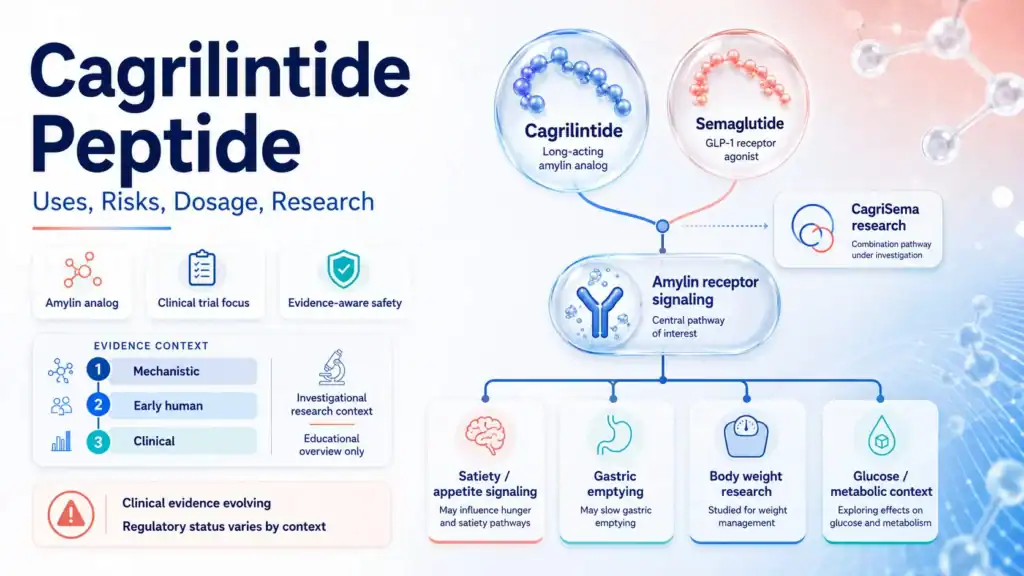
Cagrilintide peptide is a long-acting, lipidated amylin analog studied for obesity and weight management, most visibly as part of CagriSema, an investigational fixed-dose combination with semaglutide 1 11. This educational guide explains what cagrilintide is, how it is thought to work, what human trials and preclinical research suggest, and where the evidence remains limited. It does not provide personalized medical advice, dosing instructions, injection technique, or guidance on obtaining unapproved peptides.
- Cagrilintide is described in pharmacology databases as a peptide and long-acting amylin analog with activity at calcitonin-family receptors, including amylin and calcitonin receptor pathways [1].
- It is mainly discussed for obesity and weight management research, including studies of cagrilintide alone and cagrilintide with semaglutide 6 7.
- CagriSema combines cagrilintide 2.4 mg and semaglutide 2.4 mg in once-weekly study protocols, but it was not approved in the United States or European Union as of Novo Nordisk’s December 2025 regulatory announcement [11].
- Human evidence includes phase 1b, phase 2, and phase 3 clinical trial data, including trials in adults with overweight or obesity and in people with type 2 diabetes [6] 8 9 10.
- Potential benefits center on body weight reduction, appetite-related outcomes, and metabolic markers, but these findings must be interpreted by trial design, population, comparator, and regulatory status [9] [10].
- Reported adverse events have commonly included gastrointestinal events, especially in combination trials, and safety interpretation should account for semaglutide-related labeling issues as well as cagrilintide-specific evidence gaps [11] 14.
- Dosage and administration information in this article refers only to approved labels for comparator drugs or published study contexts; study doses should not be treated as personal dosage advice [6] [9] [10].
Fast Answer
Cagrilintide peptide is a long-acting amylin analog being studied for obesity and weight management, including in the investigational cagrilintide-and-semaglutide combination known as CagriSema [1] [11]. People search for it because human trials have reported body weight reduction and metabolic outcomes, but the evidence depends on whether the claim comes from phase 2 studies, phase 3 trials, regulatory filings, or mechanistic research [6] [9] [10]. Safety, dosage, and legal status require caution because cagrilintide-containing products were still investigational in key jurisdictions as of recent public updates [11].
What Is the Cagrilintide Peptide?
Cagrilintide is a synthetic peptide drug candidate derived from the biology of amylin, a hormone involved in meal-related satiety and glucose regulation [1]. PubChem lists cagrilintide as a compound under clinical investigation and provides molecular information for the molecule, but compound identity alone does not establish clinical benefit or approval status 2.
The phrase “cagrilintide peptide” is often used in search because cagrilintide belongs to a peptide-based therapeutic research lane. In medical literature, the more precise framing is that cagrilintide is a long-acting amylin analog being developed for metabolic disease contexts, especially obesity and weight management 3 4.
Cagrilintide as a Long-Acting Amylin Analog
Cagrilintide is a long-acting amylin analog designed to improve pharmacologic properties compared with native amylin, including structural changes intended to reduce fibril formation and prolong activity [1] [3]. A medicinal chemistry development paper describes cagrilintide as a long-acting amylin analogue developed for obesity pharmacotherapy research [3].
Amylin is normally co-secreted with insulin from pancreatic beta cells and contributes to post-meal metabolic regulation, including satiety-related signaling [4]. Cagrilintide is not the same as native amylin, and it should not be assumed to behave identically in every tissue or clinical setting [1] 5.
Why Is This Peptide Studied for Obesity and Weight Management?
Obesity is a chronic disease area where regulators, researchers, and clinicians evaluate anti-obesity medications by weight change, metabolic outcomes, safety, durability, and impact on obesity-related comorbidities [9] [10]. Cagrilintide is studied because amylin-pathway agonism may complement GLP-1 receptor agonist therapy through effects on appetite, satiety, and energy intake [4].
The strongest human data for cagrilintide now come from clinical trials, not from peptide vendor claims or anecdotal online reports [6] [9] [10]. That distinction matters because trial outcomes are measured under controlled conditions, while informal online claims often lack verified product identity, safety monitoring, and complete adverse-event reporting 13.
How Does It Differ From GLP-1 Agonist Therapy?
Cagrilintide is best understood as an amylin analog, while semaglutide is a GLP-1 receptor agonist approved in specific formulations and indications, including weight-management uses described in FDA labeling [1] [14]. These categories overlap in obesity treatment research because both may affect appetite and body weight, but they act through different receptor systems [4] [14].
CagriSema is designed to combine cagrilintide and semaglutide, which means evidence for the combination should not automatically be treated as evidence for cagrilintide alone [7] [9]. The same caution applies in reverse: cagrilintide monotherapy findings do not automatically predict the full safety or efficacy profile of combination therapy [6] [9].
How Does Cagrilintide Peptide Work?
Cagrilintide is thought to work through amylin-related and calcitonin-family receptor signaling that influences satiety, appetite, and metabolic regulation [1] [5]. This mechanism is biologically plausible, but clinical outcomes still need to be judged by human trial data rather than receptor activity alone [5] [9].
Which Receptors Are Involved in the Mechanism of Action?
The Guide to Pharmacology describes cagrilintide as a nonselective agonist of calcitonin-family receptors, including amylin and calcitonin receptors [1]. A 2025 structural study reported cagrilintide binding to active AMY1R, AMY2R, AMY3R, and calcitonin receptor complexes, adding mechanistic detail about how the molecule interacts with this receptor family [5].
Amylin receptors are formed by calcitonin receptor complexes with receptor activity-modifying proteins, often abbreviated as RAMPs, and this receptor architecture helps explain why amylin analogs can have distinct signaling profiles [5]. This receptor-level evidence supports mechanism of action, but it is not the same as a clinical outcome trial [5].
How Might Satiety, Appetite Suppression, and Food Intake Change?
Amylin biology is linked to satiety and food-intake regulation, and reviews describe amylin-related signaling in both homeostatic and hedonic brain regions involved in eating behavior [4]. FDA labeling for pramlintide, an approved amylin analog for diabetes patients using mealtime insulin, describes effects of amylin analog therapy on gastric emptying, glucagon suppression, and food intake modulation 16.
For cagrilintide, appetite suppression and reduced food intake should be discussed as studied or proposed mechanisms, not as guaranteed individual effects [4] [6]. Human trials measure group-level outcomes, and an individual person’s response can vary due to medical history, other medications, adherence, adverse events, and trial eligibility differences [9] [10].
Why Mechanism Does Not Guarantee Clinical Outcomes
A receptor agonist can look promising mechanistically and still show limited, mixed, or safety-constrained results in human use. Cagrilintide’s receptor activity helps explain why it is being studied, but trials are needed to evaluate body weight, glucose, adverse events, discontinuation, and longer-term safety [5] [9] [10].
This distinction is especially important for peptide therapy discussions online. Mechanistic claims are often presented as if they prove real-world outcomes, but clinical evidence requires controlled human data, appropriate comparators, and transparent safety reporting [6] [9] [13].
What Is Cagrilintide Peptide Used For in Research?
Cagrilintide has been studied in weight management research as monotherapy and in combination with semaglutide [6] [7] [9]. It has also been evaluated in populations with type 2 diabetes and excess body weight, where both weight and glycemic endpoints are relevant [8] [10].
Obesity Treatment and Long-Term Body Weight Management
A phase 2 trial evaluated once-weekly cagrilintide for weight management in adults with overweight or obesity, using multiple dose levels and comparing outcomes with placebo and liraglutide 3.0 mg [6]. The trial supports clinical interest in cagrilintide monotherapy, but it does not establish cagrilintide as an approved obesity treatment [6] [11].
CagriSema phase 3 trials evaluated once-weekly cagrilintide 2.4 mg and semaglutide 2.4 mg in adults with overweight or obesity over 68 weeks [9] [11]. The results are clinically relevant as trial data, but regulatory approval depends on agency review of the full evidence package, labeling, manufacturing quality, and risk-benefit assessment [11].
Which Obesity and Type 2 Diabetes Populations Are Studied?
REDEFINE 1 evaluated adults with overweight or obesity, while REDEFINE 2 evaluated adults with overweight or obesity and type 2 diabetes [9] [10]. The REDEFINE 2 publication reported that cagrilintide-semaglutide led to greater body-weight reduction than placebo and improved HbA1c outcomes in the trial population [10].
CagriSema has also been studied in type 2 diabetes research beyond weight management, including the REIMAGINE 2 phase 3 program reported by Novo Nordisk in 2026 12. Company announcements can be useful for current trial status, but peer-reviewed publications and regulator documents remain preferred for final clinical interpretation [12].
Potential Benefits of Cagrilintide Peptide
Potential benefits should be separated by evidence level. For cagrilintide, the most credible benefit discussions involve body weight reduction in clinical trials, appetite-related mechanisms, and metabolic outcomes in specific studied populations [6] [9] [10].
What Does Research Suggest About Weight Reduction?
In the 2021 phase 2 dose-finding trial, once-weekly cagrilintide was associated with greater body-weight reduction than placebo over the study period in adults with overweight or obesity [6]. In REDEFINE 1, coadministered cagrilintide and semaglutide produced significantly greater body-weight reduction than placebo in adults with overweight or obesity [9].
Novo Nordisk’s regulatory announcement reported REDEFINE 1 treatment-policy estimand results of 20.4% mean body-weight reduction with CagriSema versus 3.0% with placebo, and trial-product estimand results of 22.7% versus 2.3% [11]. These figures are trial results, not predictions of individual outcomes [9] [11].
Appetite, Satiety, and Food-Craving Outcomes
Amylin-pathway biology supports research interest in satiety, appetite suppression, and food intake, and cagrilintide’s mechanism is aligned with this therapeutic hypothesis [1] [4]. Pramlintide labeling also supports the broader concept that amylin analogs can influence satiety-related mechanisms and gastric emptying, although pramlintide and cagrilintide are different drugs with different development contexts [16].
Food craving and appetite outcomes are harder to interpret than body-weight endpoints because they depend on measurement tools, trial design, duration, and participant characteristics. Claims that cagrilintide reliably reduces appetite for every person should be treated as unsupported unless tied to specific study outcomes [6] [9].
Which Cardiometabolic Markers Are Studied Beyond Mean Weight?
Cagrilintide-semaglutide trials in type 2 diabetes have evaluated HbA1c and body-weight endpoints, making glucose-related outcomes relevant for the studied populations [8] [10]. REDEFINE 2 reported that a larger proportion of participants receiving cagrilintide-semaglutide achieved HbA1c of 6.5% or lower compared with placebo [10].
Novo Nordisk’s REIMAGINE 2 announcement reported HbA1c and weight changes in adults with type 2 diabetes who were inadequately controlled on metformin with or without an SGLT2 inhibitor [12]. Because this was a company announcement rather than the final peer-reviewed trial publication, it should be interpreted as current development information rather than complete independent evidence [12].
What Does Human Clinical Trial Evidence Show?
Human evidence for cagrilintide includes early combination work, phase 2 monotherapy and type 2 diabetes studies, and phase 3 CagriSema trials [6] [7] [8] [9] [10]. The evidence is strongest for endpoints actually measured in these trials, such as body weight, HbA1c in type 2 diabetes studies, tolerability, and adverse-event rates [9] [10].
| Evidence Area | What Has Been Studied | Evidence Level | What It Can and Cannot Show |
|---|---|---|---|
| Cagrilintide identity and receptor pharmacology | Peptide identity, amylin analog design, calcitonin-family receptor activity [1] [3] [5] | Mechanistic / preclinical | Supports biological plausibility, but does not prove clinical benefit. |
| Cagrilintide monotherapy | Once-weekly cagrilintide dose-finding in adults with overweight or obesity [6] | Clinical evidence | Shows trial-level weight-management outcomes and tolerability over a defined period; does not establish approval. |
| Cagrilintide with semaglutide phase 1b | Safety, tolerability, pharmacokinetics, and pharmacodynamics of multiple doses with semaglutide 2.4 mg [7] | Early human evidence | Supports early combination feasibility; small early trials cannot define long-term outcomes. |
| REDEFINE 1 | CagriSema in adults with overweight or obesity, with ClinicalTrials.gov registration NCT05567796 [9] 17 | Phase 3 clinical evidence | Supports efficacy and safety assessment in a large trial population; regulatory labeling still depends on agency review. |
| REDEFINE 2 | CagriSema in adults with overweight or obesity and type 2 diabetes, NCT05394519 [10] 18 | Phase 3 clinical evidence | Supports body-weight and HbA1c findings in type 2 diabetes; does not automatically apply to all patients. |
Phase 1b, Phase 2, and Phase 3 Trial Context
The phase 1b trial evaluated concomitant cagrilintide with semaglutide 2.4 mg for safety, tolerability, pharmacokinetics, and pharmacodynamics [7]. Early-phase studies are useful for development decisions, but they are not designed to answer every long-term safety or comparative effectiveness question [7].
The phase 2 cagrilintide monotherapy trial studied once-weekly subcutaneous cagrilintide across multiple dose levels, with placebo and liraglutide 3.0 mg comparators [6]. Phase 3 REDEFINE trials then evaluated the cagrilintide-semaglutide combination in larger populations and longer treatment periods [9] [10].
CagriSema Evidence for Cagrilintide and Semaglutide
CagriSema is the name used for the fixed-dose combination of cagrilintide 2.4 mg and semaglutide 2.4 mg [11]. In REDEFINE 1 and REDEFINE 2, CagriSema was studied as a once-weekly therapy with lifestyle intervention, and the published findings reported significant weight-related outcomes compared with placebo [9] [10].
The phase 2 type 2 diabetes trial found that once-weekly cagrilintide 2.4 mg with semaglutide 2.4 mg produced greater weight loss than semaglutide alone or cagrilintide alone in that study population [8]. That finding is about a specific randomized clinical trial, not a general instruction to combine therapies outside approved labeling or clinician supervision [8].
How Do Placebo-Controlled and Active-Controlled Trials Differ?
A placebo-controlled trial estimates the effect of a treatment compared with an inactive comparator under trial conditions. An active-controlled trial compares a treatment with another active therapy, which can help answer a different question: not just whether the therapy works better than placebo, but how it compares with existing pharmacotherapy [6] [9].
The cagrilintide phase 2 dose-finding trial included placebo and liraglutide 3.0 mg comparators, while later CagriSema trials compared the combination with placebo and, in some cases, active components or other active therapies [6] [9] 20. These designs should not be blended together when interpreting benefit, safety, or comparative claims [6] [20].
What Does Preclinical Research Suggest?
Preclinical and mechanistic research helps explain why cagrilintide is being investigated. It cannot replace human clinical evidence.
Animal-Model Evidence on Amylin and Calcitonin Receptors
Cagrilintide development work and receptor pharmacology research support its classification as a long-acting amylin analog with calcitonin-family receptor activity [1] [3]. Structural research shows how cagrilintide binds amylin and calcitonin receptor complexes, which helps clarify receptor-level pharmacology [5].
Animal and receptor studies can suggest biologically plausible effects on satiety or food intake, but these findings do not prove that every human population will experience meaningful weight reduction or acceptable safety. Human trials remain necessary to assess efficacy and safety in the intended clinical population [6] [9] [10].
What Are the Translational Limits of Preclinical Findings?
Preclinical studies can isolate receptor activity, structure, and signaling in ways that are not possible in large human trials. Their main limitation is that receptor activity does not fully capture human disease complexity, long-term adherence, medication interactions, pregnancy considerations, comorbidities, or real-world adverse-event reporting [5] [13].
For cagrilintide, preclinical evidence should be used to explain mechanism, not to market outcomes. Clinical claims should come from human trials, official labeling, regulator documents, or peer-reviewed publications [6] [9] [10].
Where Is the Evidence for Cagrilintide Still Limited?
The evidence base is stronger than anecdotal claims because multiple human trials exist, but it is still incomplete. Long-term durability, post-approval pharmacovigilance, broader special-population safety, and real-world comparative effectiveness remain areas to watch [9] [10] [11].
Short-Term Trial Data Versus Sustained Weight Loss Questions
REDEFINE trials provide 68-week evidence, which is meaningful for obesity pharmacotherapy research but still not the same as many years of post-marketing experience [9] [10]. Novo Nordisk has also reported additional trial programs, including REIMAGINE and head-to-head REDEFINE work, but some results are available as company announcements before full peer-reviewed publication [12] [20].
Sustained weight loss questions include what happens after discontinuation, how adverse events affect adherence, whether benefits persist across subgroups, and how treatment compares with approved alternatives in routine care. These questions require longer-term data and transparent safety follow-up [9] [10] [20].
Which Claims Remain Unsupported by Published Evidence?
Claims that cagrilintide peptide is “best,” “risk-free,” “guaranteed,” or appropriate for self-directed use are not supported by the evidence reviewed here. FDA warnings about unapproved GLP-1-related products also highlight risks from products marketed directly to consumers or falsely labeled for research use [13].
Unsupported online claims may blur the distinction between investigational drug development, compounded products, and unverified peptide products. Those categories are not equivalent to approved medicines reviewed for manufacturing quality, labeling, dosing, safety, and specific indications [13] [14].
Side Effects and Adverse Events Reported in Studies
The most common adverse-event theme in cagrilintide-semaglutide trials has been gastrointestinal tolerability, although rates vary by trial, population, dose, comparator, and reporting method [10] [11]. Adverse event data should be interpreted alongside discontinuation rates and severity, not just whether an event occurred [10] [11].
Gastrointestinal Adverse Events Such as Nausea or Vomiting
Novo Nordisk’s REDEFINE 1 announcement reported gastrointestinal adverse events in 79.6% of participants receiving CagriSema compared with 39.9% receiving placebo, including nausea, constipation, and vomiting [11]. REDEFINE 2 reported gastrointestinal adverse events in 72.5% of participants receiving cagrilintide-semaglutide and 34.4% receiving placebo, with most events described as transient and mild to moderate [10].
These findings do not mean every person will have gastrointestinal adverse events, but they do show that tolerability is central to the safety discussion. Semaglutide labeling also lists gastrointestinal adverse reactions among common adverse reactions for Wegovy, which matters when interpreting CagriSema as a combination therapy [14].
How Does Adverse Event Reporting Differ Across Trials?
Adverse-event rates can differ because trials enroll different populations, use different comparators, last for different durations, and apply different escalation or monitoring protocols [6] [7] [10]. A phase 1b safety study cannot answer the same questions as a larger phase 3 trial, and a type 2 diabetes trial cannot automatically be generalized to all people seeking weight management [7] [10].
A careful reader should look for event severity, timing, discontinuation, serious adverse events, and whether events cluster during dose escalation or persist later. For CagriSema, discontinuation due to adverse events was reported in regulatory announcements and trial publications, but final labeling would depend on regulator review if approval is granted [10] [11].
Safety Considerations for Cagrilintide and CagriSema
Safety interpretation is different for cagrilintide alone versus cagrilintide combined with semaglutide. Combination therapy may produce additive or different benefit and risk patterns because each component has its own pharmacology [4] [14].
Why Can Combination Therapy Change the Safety Profile?
Semaglutide has FDA labeling that includes warnings and precautions such as acute pancreatitis, gallbladder disease, hypoglycemia risk when used with insulin or insulin secretagogues, kidney injury related to volume depletion, severe gastrointestinal adverse reactions, hypersensitivity, diabetic retinopathy complications in patients with type 2 diabetes, heart-rate increase, and pulmonary aspiration during anesthesia or deep sedation [14]. Those labeling issues do not automatically become cagrilintide warnings, but they are relevant when cagrilintide is combined with semaglutide [11] [14].
Pramlintide, an approved amylin analog used with mealtime insulin in diabetes, carries a boxed warning for severe hypoglycemia when used with insulin and is contraindicated in people with hypoglycemia unawareness or confirmed gastroparesis [16]. Cagrilintide is a different molecule, but pramlintide labeling helps explain why amylin-pathway therapies deserve careful discussion in diabetes, gastric-emptying, and medication-review contexts [16].
When Should Glucose, Insulin, and Type 2 Diabetes Monitoring Be Discussed?
Glucose monitoring and medication review are especially relevant in people with type 2 diabetes, people using insulin, or people using insulin secretagogues [10] [14]. REDEFINE 2 and phase 2 type 2 diabetes research evaluated cagrilintide-semaglutide in populations where HbA1c and weight outcomes were both relevant [8] [10].
A clinician discussion checklist may include: current diabetes medications, insulin or sulfonylurea use, history of severe hypoglycemia, gastrointestinal disease, gallbladder or pancreatic history, kidney disease risk during dehydration, pregnancy or breastfeeding status, and whether a product is approved or investigational in the reader’s jurisdiction [14] [16]. This checklist is for discussion, not self-treatment.
Contraindications and Patient Groups Requiring Caution
Cagrilintide did not have FDA-approved prescribing information as a standalone medicine or as part of CagriSema at the time of the cited regulatory announcement, so there is no FDA-labeled contraindication list for cagrilintide comparable to an approved drug label [11]. Caution should therefore come from clinical trial eligibility, component-drug labeling, related amylin analog labeling, and clinician judgment rather than assumptions from marketing claims [14] [16].
Pregnancy, Breastfeeding, and Reproductive-Safety Uncertainty
Semaglutide labeling states that weight-loss treatment with Wegovy may cause fetal harm and that it should be discontinued when pregnancy is recognized; the label also includes breastfeeding-specific information that depends on the formulation [14]. These semaglutide labeling statements are directly relevant to semaglutide-containing combination therapy discussions, including CagriSema research context [11] [14].
For cagrilintide itself, reproductive-safety conclusions should not be overstated without approved labeling or robust human pregnancy data. People who are pregnant, planning pregnancy, or breastfeeding should discuss the evidence, approved alternatives, and unknowns with a licensed clinician.
Gastrointestinal Disease, Pancreatitis History, and Complex Comorbidities
Semaglutide labeling includes warnings about pancreatitis, gallbladder disease, severe gastrointestinal adverse reactions, and acute kidney injury related to volume depletion [14]. Pramlintide labeling contraindicates use in confirmed gastroparesis and highlights severe hypoglycemia risk with insulin in selected diabetes populations [16].
These labels do not create a final contraindication list for cagrilintide, but they show why gastrointestinal disease, pancreatitis history, diabetes medications, kidney risk, and complex comorbidities belong in clinician-led safety review [14] [16]. Trial populations often exclude some higher-risk groups, so published tolerability may not represent every real-world patient [6] [10].
Drug Interactions and Medication Review Questions
Drug interactions should be evaluated in context. Cagrilintide’s investigational status means interaction guidance is less settled than it is for approved drugs with complete prescribing information [11].
How Could GLP-1 Receptor Agonist Therapy Affect Interaction Review?
Semaglutide labeling states that Wegovy delays gastric emptying and may affect absorption of concomitantly administered oral medications, with additional attention for medicines that have a narrow therapeutic index [14]. This is relevant to cagrilintide with semaglutide because CagriSema includes semaglutide as one component [11] [14].
Interaction review should also consider overlapping gastrointestinal adverse effects, dehydration risk from vomiting or diarrhea, and peri-procedural considerations such as anesthesia-related aspiration warnings described in semaglutide labeling [14]. These are medical review topics, not reasons for self-adjusting prescribed medications.
Diabetes Medications, Insulin, and Hypoglycemia Risk Context
Semaglutide labeling warns about hypoglycemia risk when used with insulin or insulin secretagogues [14]. Pramlintide labeling highlights severe hypoglycemia risk when the amylin analog is used with insulin, especially in type 1 diabetes, and describes patient-selection cautions [16].
Because CagriSema trials include populations with type 2 diabetes, medication review should consider insulin, sulfonylureas, glucose monitoring, HbA1c goals, and hypoglycemia history [8] [10]. No reader should infer from trial dosing that they should change diabetes medication without clinician supervision.
What Dosage Information Exists From Studies?
Dosage information for cagrilintide should be limited to published studies and regulatory-development context. It should not be converted into a personal protocol.
Cagrilintide 2.4 mg and Semaglutide 2.4 mg in CagriSema Trials
The cagrilintide phase 2 dose-finding trial evaluated once-weekly subcutaneous cagrilintide at several dose levels, including 0.3 mg, 0.6 mg, 1.2 mg, 2.4 mg, and 4.5 mg, with placebo and active comparator arms [6]. Later CagriSema studies commonly evaluated cagrilintide 2.4 mg and semaglutide 2.4 mg as a once-weekly combination [8] [9] [10] [11].
Study doses should not be interpreted as personal dosing advice. Trial dosing is tied to inclusion criteria, exclusion criteria, dose-escalation methods, monitoring, rescue rules, adverse-event management, and research oversight [6] [9] [10].
Why Are Study Doses Not Personal Dosage Advice?
A trial protocol is not the same as a prescription for an individual reader. Medical dosing decisions depend on diagnosis, approved indication, product labeling, kidney and liver context, current medications, pregnancy status, adverse-event history, and jurisdictional regulatory status [14] [16].
This is especially important for investigational or unapproved peptides, where product quality, concentration, labeling, and safety oversight may be uncertain outside regulated pathways [13]. Readers should not use published trial doses to create a self-directed dosing, cycling, stacking, or injection plan.
Administration Routes Discussed in Medical Literature
Cagrilintide has been studied in once-weekly subcutaneous administration protocols [6] [9] [10]. This route information is useful for interpreting the literature, but it is not an injection guide.
Once-Weekly Subcutaneous Administration in Study Protocols
The phase 2 cagrilintide trial studied once-weekly subcutaneous administration in a controlled clinical research setting [6]. REDEFINE 1 and REDEFINE 2 also evaluated once-weekly cagrilintide-semaglutide treatment under clinical trial conditions [9] [10].
Administration details in trials are part of research methods. They should not be separated from the medical oversight, eligibility criteria, product controls, and safety monitoring built into those studies [6] [9] [10].
How Does Route Information Differ From Self-Administration Instructions?
Route of administration describes how a therapy was delivered in literature or labeling; it does not teach a reader how to administer it. This article does not provide injection steps, reconstitution directions, device instructions, or storage instructions for investigational or unapproved products.
The distinction matters because unapproved products may have unknown quality, concentration, sterility, or labeling accuracy. FDA has warned that unapproved products marketed for weight loss may be counterfeit, contaminated, contain the wrong amount of active ingredient, or lack active ingredient entirely [13].
Is Cagrilintide Peptide FDA-Approved or Investigational?
Cagrilintide-containing CagriSema was described by Novo Nordisk in December 2025 as submitted to the FDA for weight-management approval, and the same announcement stated that CagriSema was not approved in the United States or European Union at that time [11]. Regulatory status can change, so readers and editors should verify approval status against current FDA, EMA, or national regulator databases before publication or medical decision-making.
Regulatory Status of Cagrilintide, CagriSema, and Novo Nordisk Development
Novo Nordisk’s 2025 filing announcement described CagriSema as a fixed-dose combination of cagrilintide 2.4 mg and semaglutide 2.4 mg for chronic weight-management review [11]. A 2026 Novo Nordisk update stated that an FDA decision was anticipated by late 2026, but company timelines are not the same as approval [20].
Cagrilintide alone should also be separated from CagriSema. A combination product may have a different development path, label, risk profile, and clinical role than cagrilintide monotherapy [6] [9] [11].
What Are the Risks of Compounded or Unapproved Peptides?
FDA has warned about unapproved GLP-1-related products marketed directly to consumers, including products falsely labeled “research” or “not for human consumption” while being sold with dosing instructions [13]. The FDA notes that unapproved or illegally marketed products may contain too much, too little, none of, or the wrong active ingredient, and may expose users to quality and safety risks [13].
Those concerns apply broadly to unapproved peptide and obesity-drug markets. An investigational peptide discussed in trials is not equivalent to an online product with uncertain identity, potency, sterility, storage history, or labeling [13].
How Does Cagrilintide Compare With Related Therapies?
Comparisons should focus on mechanism, evidence, regulatory status, and safety. They should not rank drugs as “best” for every person.
Cagrilintide vs Semaglutide: Amylin Analog Versus GLP-1 Receptor Agonist
Cagrilintide is an amylin analog with calcitonin-family receptor activity, while semaglutide is a GLP-1 receptor agonist described in FDA labeling for approved semaglutide products such as Wegovy [1] [14]. Semaglutide has approved prescribing information for specific indications, warnings, contraindications, and dosing instructions, while cagrilintide-containing CagriSema was investigational in the cited regulatory update [11] [14].
The combination rationale is that amylin and GLP-1 pathways may have complementary effects on appetite and body-weight regulation [4]. Still, combination evidence should be judged by CagriSema trials rather than by adding together assumptions from each component [7] [9].
Cagrilintide vs Tirzepatide: Different Receptor Agonist Strategies
Tirzepatide is a dual GIP and GLP-1 receptor agonist with FDA prescribing information for Zepbound, while cagrilintide is an amylin analog studied alone and with semaglutide [1] 15. These therapies use different receptor strategies, so comparisons should consider mechanism, approved status, trial design, patient population, adverse events, and endpoints [15] [20].
The REDEFINE 4 trial compared CagriSema with tirzepatide in adults with obesity, and the ClinicalTrials.gov record identifies the study as a comparison of CagriSema with tirzepatide for body-weight outcomes 19. Novo Nordisk reported that CagriSema achieved 23.0% body-weight reduction under the trial-product estimand but did not meet the primary endpoint of showing non-inferiority compared with tirzepatide 15 mg in that open-label trial [20].
The safest way to interpret cagrilintide peptide is through evidence quality, regulatory status, safety data, and clinician-guided decision-making. The strongest conclusions come from approved labeling and well-designed human studies; weaker claims, especially those from online peptide markets or anecdotal reports, should be treated cautiously.
REFERENCES
- IUPHAR/BPS Guide to Pharmacology. Cagrilintide ligand page. Guide to Pharmacology Database, Ligand ID 13768. 2026.
- National Center for Biotechnology Information. Cagrilintide. PubChem Compound Database. 2026.
- Kruse T, Hansen JL, Dahl K, et al. Development of Cagrilintide, a Long-Acting Amylin Analogue. Journal of Medicinal Chemistry. 2021. DOI: 10.1021/acs.jmedchem.1c00565. PMID: 34288673.
- D’Ascanio AM, Liu X, Brown E, et al. Cagrilintide: A Long-Acting Amylin Analog for the Treatment of Obesity. Cardiology in Review. 2024. DOI: 10.1097/CRD.0000000000000513. PMID: 36883831.
- Cao J, Chen S, Ma S, et al. Structural and dynamic features of cagrilintide binding to calcitonin and amylin receptors. Nature Communications. 2025. DOI: 10.1038/s41467-025-58680-y.
- Lau DCW, Erichsen L, Francisco AM, et al. Once-weekly cagrilintide for weight management in people with overweight and obesity: a multicentre, randomised, double-blind, placebo-controlled and active-controlled, dose-finding phase 2 trial. The Lancet. 2021;398:2160–2172. DOI: 10.1016/S0140-6736(21)01751-7. PMID: 34798060.
- Enebo LB, Berthelsen KK, Kankam M, et al. Safety, tolerability, pharmacokinetics, and pharmacodynamics of concomitant administration of multiple doses of cagrilintide with semaglutide 2.4 mg for weight management. The Lancet. 2021;397:1736–1748. DOI: 10.1016/S0140-6736(21)00845-X. PMID: 33894838.
- Frias JP, Deenadayalan S, Erichsen L, et al. Efficacy and safety of co-administered once-weekly cagrilintide 2.4 mg with once-weekly semaglutide 2.4 mg in type 2 diabetes. The Lancet. 2023;402:720–730. DOI: 10.1016/S0140-6736(23)01163-7. PMID: 37364590.
- Garvey WT, Batterham RL, Bhatta M, et al.; REDEFINE 1 Study Group. Coadministered Cagrilintide and Semaglutide in Adults with Overweight or Obesity. New England Journal of Medicine. 2025;393:635–647. DOI: 10.1056/NEJMoa2502081. PMID: 40544433.
- Davies MJ, Buse JB, De Block C, et al. Cagrilintide–Semaglutide in Adults with Overweight or Obesity and Type 2 Diabetes. New England Journal of Medicine. 2025. DOI: 10.1056/NEJMoa2502082. PMID: 40544432.
- Novo Nordisk. Novo Nordisk files for FDA approval of CagriSema, the first once-weekly combination of GLP-1 and amylin analogues for weight management. Company regulatory announcement. 2025.
- Novo Nordisk. CagriSema demonstrated superior HbA1c reduction and weight loss in adults with type 2 diabetes in the REIMAGINE 2 trial. Company clinical-development announcement. 2026.
- U.S. Food and Drug Administration. FDA’s Concerns with Unapproved GLP-1 Drugs Used for Weight Loss. FDA Drug Safety and Availability. 2026.
- U.S. Food and Drug Administration. WEGOVY semaglutide prescribing information. FDA label. Revised February 2026.
- U.S. Food and Drug Administration. ZEPBOUND tirzepatide prescribing information. FDA label. Revised January 2026.
- U.S. Food and Drug Administration. SYMLIN pramlintide acetate prescribing information. FDA label. Revised June 2014.
- ClinicalTrials.gov. A Research Study to See How Well CagriSema Helps People With Excess Body Weight Lose Weight, NCT05567796. U.S. National Library of Medicine.
- ClinicalTrials.gov. A Research Study to See How Well CagriSema Helps People With Type 2 Diabetes and Excess Body Weight Lose Weight, NCT05394519. U.S. National Library of Medicine.
- ClinicalTrials.gov. A Research Study to See How Well CagriSema Compared to Tirzepatide Helps People With Obesity Lose Weight, NCT06131437. U.S. National Library of Medicine.
- Novo Nordisk. CagriSema demonstrated 23% weight loss in an open-label head-to-head REDEFINE 4 trial in people with obesity, the primary endpoint was not achieved. Company clinical-development announcement. 2026.
Contributing Authors
The following authors are recognized for published research that helped shape the scientific and clinical context discussed in this article.
W. Timothy Garvey
Author profile: University of Alabama at Birmingham Scholars
W. Timothy Garvey is recognized for publications that help frame the clinical evidence surrounding Cagrilintide peptide and the broader obesity pharmacotherapy literature. His REDEFINE 1 publication is directly relevant to interpreting cagrilintide–semaglutide data in adults with overweight or obesity, including study design, endpoints, and safety reporting. His SURMOUNT-2 work also provides useful context for comparison with tirzepatide in populations with obesity and type 2 diabetes. Together, these publications support an evidence-focused view of trial design, comparator selection, and patient-population differences rather than implying a single best therapy for all readers.
Selected publications:
- Coadministered Cagrilintide and Semaglutide in Adults with Overweight or Obesity — New England Journal of Medicine, 2025. DOI: 10.1056/NEJMoa2502081. PMID: 40544433
- Tirzepatide once weekly for the treatment of obesity in people with type 2 diabetes: SURMOUNT-2 — The Lancet, 2023. DOI: 10.1016/S0140-6736(23)01200-X. PMID: 37385275
Melanie J. Davies
Author profile: University of Leicester Profile
Melanie J. Davies is recognized for publications relevant to CagriSema and GLP-1–based clinical research in adults with type 2 diabetes and excess body weight. Her REDEFINE 2 publication is central to understanding cagrilintide–semaglutide evidence in a diabetes population, including body-weight, glycemic, tolerability, and safety outcomes reported under trial conditions. Her STEP 2 semaglutide publication provides related context for how semaglutide 2.4 mg has been studied in adults with overweight or obesity and type 2 diabetes. These publications help readers distinguish published literature from personal medical decisions and regulatory status questions.
Selected publications:
- Cagrilintide–Semaglutide in Adults with Overweight or Obesity and Type 2 Diabetes — New England Journal of Medicine, 2025. DOI: 10.1056/NEJMoa2502082. PMID: 40544432
- Semaglutide 2.4 mg once a week in adults with overweight or obesity, and type 2 diabetes: STEP 2 — The Lancet, 2021. DOI: 10.1016/S0140-6736(21)00213-0. PMID: 33667417