
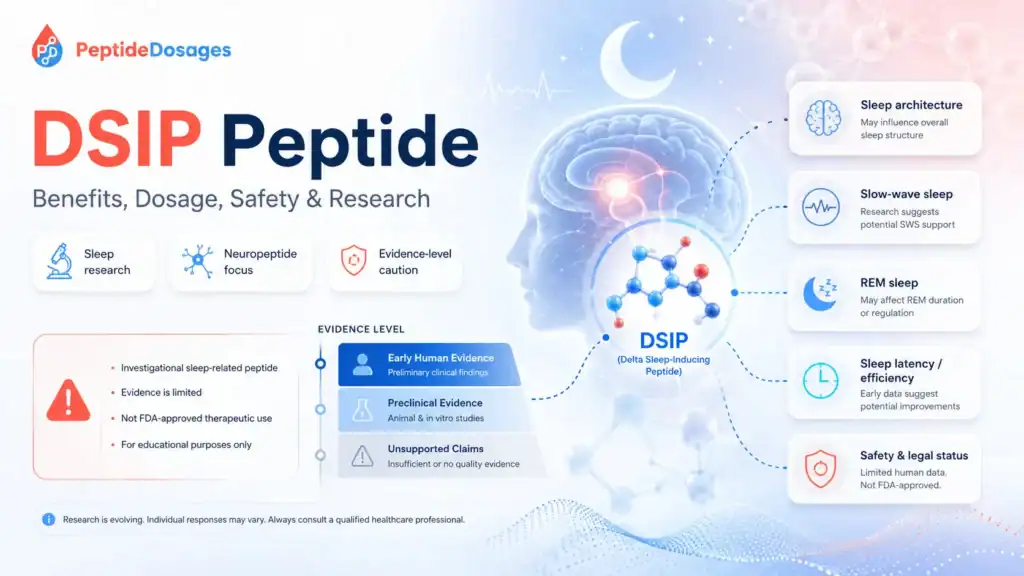
DSIP peptide, also called delta sleep-inducing peptide, is a small nonapeptide discussed in sleep research because early experiments reported delta electroencephalography activity after isolation from rabbit cerebral venous blood 1 2. This educational guide reviews what is known about DSIP, how it is thought to interact with sleep-wake biology, and why clinical evidence remains limited 3. It does not recommend any peptide therapy, dose, injection, vendor, or self-treatment plan.
- DSIP is a delta sleep inducing peptide described as a small peptide sequence, but its role as a clinically useful sleep treatment remains unproven [1] [3].
- Early research connected delta-sleep-inducing peptide with rabbit EEG findings and later human sleep studies, but the evidence base is old, small, and inconsistent [2] [3].
- DSIP is not listed as an approved insomnia medication in major U.S. or European regulator databases reviewed for this article 4 5 6.
- A ClinicalTrials.gov search does not show a modern, large DSIP insomnia trial program, which limits confidence in online claims 7.
- Potential benefits of DSIP, including sleep quality, shorter sleep latency, and higher sleep efficiency, should be treated as preliminary or unsupported unless tied to a specific published study [3].
- Safety data are limited; compounded or unapproved peptides are not evaluated by FDA in the same way as approved drugs 8.
- Dosage information belongs in the context of published studies or approved labels; DSIP has no approved label dosage, and study doses should not be interpreted as personal dosing advice [4] [5].
Fast Answer
DSIP peptide is an investigational sleep-related nonapeptide, also known as delta sleep-inducing peptide, first described in early animal sleep research [1] [2]. People search for it because older studies explored possible effects on sleep, insomnia, sleep latency, and sleep efficiency, but clinical evidence remains limited and is not enough to establish DSIP as a routine sleep treatment [3]. DSIP is not an FDA- or EMA-approved insomnia drug based on major regulator databases, and safety, dosage, and administration should be interpreted cautiously [4] [6].
What Is the DSIP Peptide?
DSIP is a short peptide associated with early sleep research rather than an approved therapeutic drug. PubChem identifies delta sleep-inducing peptide as a defined chemical substance, while the medical literature describes DSIP-like activity and immunoreactivity as complicated to interpret across tissues and assays [1] [3].
Delta Sleep-Inducing Peptide as a Naturally Occurring Neuropeptide
The term delta sleep-inducing peptide comes from early reports that linked material from rabbit cerebral venous blood with delta wave activity and sleep-like EEG patterns [2]. Later reviews describe DSIP as a naturally occurring neuropeptide-like signal, but they also note that endogenous biology, measurement methods, and physiological relevance are not fully resolved [3].
Peptide Classification, Sequence Context, and DSIP-Like Molecules
DSIP is commonly described as a nonapeptide, meaning it contains nine amino acid residues [1]. A key challenge is that “DSIP-like” immunoreactivity may not always mean intact DSIP itself, because assays can detect related fragments or structurally similar material [3].
Why Is DSIP Sometimes Called a Sleep Peptide?
DSIP is sometimes called a sleep peptide because early experiments focused on sleep induction, slow-wave sleep, and delta wave activity [2] [3]. That label is historically understandable, but it should not be read as proof that DSIP safely or reliably promotes sleep in people with insomnia.
How Does DSIP Peptide Work in Sleep-Wake Regulation?
The proposed mechanism of DSIP remains uncertain. It has been discussed in relation to sleep-wake signaling, neuroendocrine regulation, and stress biology, but no single receptor or validated clinical mechanism explains all reported effects [3].
Which Brain Areas, Including the Hypothalamus and Brainstem, Are Implicated?
Human sleep regulation involves distributed circuits across the hypothalamus, brainstem, thalamus, basal forebrain, and cortex 9 10. DSIP research has been interpreted in that broader sleep-wake framework, but the peptide’s exact central nervous system targets remain less established than those of approved sleep medications [3].
What Is Known About Receptor Uncertainty, Neurotransmitters, and Circadian Rhythm?
Unlike many approved drugs, DSIP does not have a widely accepted receptor mechanism that clearly predicts clinical effects. Sleep timing and sleep pressure also depend on circadian rhythm and homeostatic sleep drive, which are separate from any single peptide signal 11.
Why Does Mechanism Not Guarantee Improved Sleep?
A biologically plausible mechanism does not prove a clinical benefit. Many compounds affect EEG, neurotransmitter signaling, or sleep stage markers in research settings without becoming safe, effective treatments for chronic insomnia [3] 12.
What Is DSIP Used For or Studied For?
DSIP has been studied mainly in sleep research, including animal experiments, small human sleep studies, and older reports involving insomnia-like symptoms [2] [3]. It has also appeared in literature on endocrine signals, stress, pain, and withdrawal-related contexts, but these areas remain preliminary [3].
| Evidence Area | What Has Been Studied | Evidence Level | What It Can and Cannot Show |
|---|---|---|---|
| Animal sleep experiments | Rabbit and rat EEG or sleep-stage observations [2] [3] | Preclinical | Can suggest biological activity, but cannot prove human treatment benefit |
| Human sleep studies | Small studies in people with poor sleep or insomnia-like symptoms [3] | Early human | Can generate hypotheses, but cannot establish routine therapy |
| Endocrine or stress signals | Cortisol, pituitary hormone, and stress-related observations [3] | Early / mechanistic | Can suggest pathways, but not clinical effectiveness |
| Lucid dreaming | Online claims and indirect sleep-stage speculation [7] | Unsupported | No strong evidence establishes DSIP for lucid dreaming |
Sleep Onset, Sleep Latency, and Sleep Efficiency Outcomes
Older DSIP studies and reviews discuss outcomes such as sleep onset, sleep latency, sleep efficiency, and sleep structure [3]. These outcomes are relevant in insomnia research, but small sample sizes and older methods limit how confidently they can be applied to modern clinical care.
Lucid Dreaming Claims: What Evidence Exists?
Lucid dreaming claims are mostly online extrapolations from DSIP’s association with sleep and REM sleep. No high-quality clinical evidence establishes that DSIP induces lucid dreaming, improves dream control, or safely changes rapid eye movement sleep for that purpose [3] [7].
Potential Benefits of DSIP Peptide: What Is Known?
The possible benefits of DSIP should be separated by evidence level. The best-supported statement is modest: DSIP has been studied for possible effects on sleep, but it is not an approved or well-established treatment for insomnia [3] [4].
Benefits of DSIP for Sleep Quality: Evidence vs Expectations
Some older reports described changes in subjective sleep quality, shorter sleep latency, or higher sleep efficiency in selected participants [3]. These findings are not the same as broad proof that DSIP improves sleep quality in the general population.
Sleep Architecture, Slow-Wave Sleep, Deep Sleep, and REM Sleep Claims
Sleep architecture includes cycling through non-REM and REM sleep stages, including slow-wave sleep and rapid eye movement sleep [9]. DSIP’s name reflects early interest in delta wave and slow wave sleep activity, but claims about reliably improving deep sleep or REM sleep remain evidence-limited [2] [3].
Natural Sleep, Restorative Sleep, and Recovery Claims
Terms like natural sleep, restorative sleep, and sleep and recovery are appealing but broad. Current evidence does not show that DSIP reliably restores normal sleep patterns, improves recovery, or replaces evidence-based insomnia care [3] 13.
DSIP and Insomnia: What Do Human Studies Suggest?
Human evidence for DSIP and insomnia is best described as early and limited. Chronic insomnia is a clinical condition that may require evaluation for medical, psychiatric, medication-related, circadian, and behavioral contributors [12] 14.
Chronic Insomnia and Severe Chronic Insomnia Study Context
Older DSIP literature includes studies involving chronic insomnia or severe chronic insomnia, but the research base is not comparable to modern large randomized trials used for approved therapies [3]. That limits confidence in claims that DSIP treatment should be used as routine peptide therapy.
Subjective Sleep Quality in Chronic Insomniac Patients
Subjective sleep quality matters because insomnia is partly defined by patient experience and daytime impairment [12]. However, subjective improvement in small or older studies can be influenced by placebo effects, study design, expectation, and sleep-lab conditions [3].
Human Sleep Research and Clinical Evidence
The human sleep research on DSIP is not absent, but it is not strong enough for high-certainty treatment claims. The most responsible interpretation is that DSIP has been studied in humans, yet clinical research remains preliminary [3].
What Did Pilot and Double-Blind Study Designs Measure?
Older pilot and double-blind study designs measured sleep-related outcomes such as latency, efficiency, awakening patterns, and sleep structure [3]. These endpoints are meaningful, but the age and scale of the studies make replication and modern methodological review important.
Plasma DSIP, Cerebral Venous Blood, and Immunoassay Challenges
The original DSIP story involved cerebral venous blood in rabbits, and later work examined plasma DSIP or DSIP-like material using immunoassay methods [2] [3]. These methods can be difficult to interpret because peptide concentration, fragments, and assay cross-reactivity may affect results [3].
Depressed Patients, Sleep Structure, and Mood-Related Findings
Depressed patients can have altered sleep structure, including changes in REM timing and sleep continuity [9] [12]. DSIP-related mood and sleep findings remain too limited to support treatment claims for depression or mood disorders [3].
Preclinical Sleep Research: Animal and Mechanistic Findings
Preclinical DSIP research helped create scientific interest in the peptide. Still, animal studies cannot establish whether a peptide is safe, effective, or clinically useful in humans.
Rabbit and Rat Models in Delta-Sleep-Inducing Peptide Research
Rabbit research is central to the original delta-sleep-inducing peptide story, and reviews also discuss animal models such as rat experiments [2] [3]. These studies can identify biological signals, but species differences and experimental conditions limit translation to human sleep disorders.
Delta Wave Activity, Electroencephalography, and Sleep Stage Data
Electroencephalography is used to identify sleep stages and delta wave activity during slow-wave sleep [9]. DSIP’s early EEG findings are scientifically interesting, but EEG changes alone do not prove improved sleep quality, daytime function, or long-term safety [2] [3].
Effects Beyond Sleep: Endocrine, Pain, and Stress Research
DSIP has been discussed beyond sleep, including endocrine signaling, stress physiology, pain, and withdrawal-related topics [3]. These areas should be treated as mechanistic or exploratory unless supported by stronger human trials.
Cortisol, Growth Hormone Secretion, and Pituitary Signals
Older literature has explored possible links between DSIP and hormones such as cortisol, growth hormone secretion, and pituitary-related pathways [3]. These observations do not establish that DSIP can safely modify endocrine function in clinical practice.
Pronounced Pain Episodes, Opioid Withdrawal, and Sedative Research Context
DSIP appears in older discussions of pronounced pain episodes, opioid withdrawal, and sedative-related research contexts [3]. These are high-risk medical areas, so DSIP should not be framed as a treatment for pain, opioid withdrawal, or sedative replacement without rigorous clinical evidence.
Evidence Limitations and Unsupported Online Claims
DSIP is a good example of why peptide claims need evidence grading. A peptide can be biologically interesting while still lacking the clinical proof needed for routine medical use.
Why Can’t Small Studies Establish Routine Peptide Therapy?
Small studies can miss uncommon side effects, overestimate benefits, and fail to represent real-world patients with comorbidities or multiple medications. Regulatory approval usually requires a stronger evidence package than preliminary peptide therapy reports [4] [5].
Why Do Online Claims That DSIP Promotes Sleep Need Caution?
The phrase “DSIP promotes sleep” is common online, but it compresses uncertain evidence into a stronger claim than the literature supports. A safer framing is that DSIP has been studied for possible effects on sleep, with unresolved questions about clinical benefit, dosing, mechanism, and safety [3].
Side Effects and Safety Concerns
Published DSIP safety information is limited compared with approved sleep medications. The absence of robust safety reports should not be interpreted as proof of safety.
What Side Effects Have Been Reported?
Older DSIP publications and reviews do not provide the type of large adverse-event database available for approved drugs [3]. Because there is no FDA-approved DSIP label, there is no regulator-reviewed adverse reaction table, contraindication list, or overdose guidance for DSIP [4] [5].
Why Are Long-Term Safety Data Limited?
Long-term safety data are limited because DSIP has not gone through modern, large-scale clinical development for insomnia. Unapproved or compounded peptides also raise quality concerns because compounded drugs are not FDA-approved before marketing [8].
Contraindications, Drug Interactions, and Medical Caution
Specific DSIP contraindications and drug interactions are not well characterized in approved labeling because no approved label exists. That uncertainty matters most for people using sleep medications, sedatives, alcohol, psychiatric medications, or drugs that affect breathing or alertness [4] [5].
Which Sleep Medications, Sedatives, or Alcohol Interactions Matter?
Approved insomnia drugs can carry risks such as next-day impairment, complex sleep behaviors, sedation, and additive central nervous system effects, depending on the medication [13] 17. Combining an unapproved sleep-related peptide with sedatives or alcohol would require clinician review because interaction data for DSIP are not established.
Who May Need Extra Caution: Sleep Apnea, Pregnancy, or Neurologic Conditions?
Sleep apnea can cause fragmented sleep, oxygen drops, and daytime sleepiness, and it requires medical evaluation rather than self-treatment with sleep aids 16. Pregnancy, breastfeeding, neurologic disorders, and endocrine conditions also require caution because DSIP lacks approved labeling and dedicated safety data for these populations [4] [5].
What Dosage Has Been Used in Published DSIP Studies?
There is no approved DSIP dosage for insomnia, lucid dreaming, recovery, or any other therapeutic use in the United States or European Union based on major regulator databases [4] [6]. Older publications used study-specific administration designs, but those details should be interpreted as research context rather than personal dosing advice [3].
Why Is There No Approved Label Dosage for DSIP?
There is no approved label dosage because DSIP is not an approved drug product with regulator-reviewed prescribing information in Drugs@FDA or the Orange Book [4] [5]. Without approved labeling, there is also no standardized indication, route, frequency, duration, contraindication list, or monitoring plan.
How Do Study Doses Differ From Personal Medical Advice?
Study doses are chosen for a research protocol, a specific population, and a defined endpoint. They should not be converted into a personal protocol because individual risk depends on diagnosis, medications, sleep disorder type, pregnancy status, breathing disorders, and product quality.
Administration Routes Discussed in the Literature
DSIP administration in early literature is mainly discussed in experimental contexts rather than routine clinical care. Route of administration matters because peptide exposure, metabolism, and central nervous system availability may differ by route, but DSIP-specific pharmacokinetic certainty is limited [3].
Injection and Intravenous Administration in Research Settings
The original animal work and later reports discussed parenteral administration, including injection or intravenous therapy in research settings [2] [3]. This article does not provide step-by-step injection, mixing, reconstitution, or self-administration instructions.
Why Do DSIP Administration Decisions Require Medical Supervision?
Administration decisions require medical context because DSIP is unapproved, safety data are limited, and product quality can vary outside regulated drug pathways [4] [8]. A clinician can also evaluate whether poor sleep is due to insomnia, sleep apnea, medication effects, mood disorders, circadian rhythm disruption, or another condition [12] [16].
Regulatory Status: Is DSIP Peptide FDA-Approved?
DSIP peptide is not an FDA-approved insomnia medication based on Drugs@FDA and Orange Book database review [4] [5]. It also is not identified as an EMA-approved medicine through the EMA medicines database reviewed for this article [6].
Unapproved, Investigational, and Compounded Peptide Considerations
Unapproved and compounded peptides should not be assumed equivalent to approved medications. FDA explains that compounded drugs are not FDA-approved, meaning FDA does not evaluate them for safety, effectiveness, or manufacturing quality before marketing [8].
How Does Approval Status Affect Legal Status, Quality, and Safety?
Approval status matters because approved medicines have regulator-reviewed labeling, manufacturing standards, dosage instructions, contraindications, and adverse event information. For DSIP, the lack of approved status means claims should be judged through published evidence, regulatory databases, and clinician-guided risk assessment [4] [5] [8].
How Does DSIP Compare With Sleep Medications and Related Therapies?
DSIP differs from approved insomnia therapies because it has no approved indication, no approved dosage, and no modern prescribing label. Evidence-based insomnia care usually starts with diagnosis, behavioral treatment, and careful consideration of approved medications when appropriate [13] [14].
DSIP vs Melatonin and Approved Insomnia Treatments
Melatonin is commonly discussed for circadian rhythm and sleep timing, while approved insomnia medications have specific labeled uses and known safety concerns [13] 15. DSIP has a different evidence profile: biologically interesting, historically studied, but not established as an approved insomnia treatment [3] [4].
Questions to Discuss With a Clinician About Human Studies and Risks
Readers considering peptide-related medical decisions can use this checklist for a clinician discussion, not as a self-treatment plan:
- What type of sleep problem is present: insomnia, sleep apnea, circadian rhythm disruption, medication effect, mood disorder, or another cause?
- Are there approved, guideline-supported options such as cognitive behavioral therapy for insomnia or approved sleep medications? [13] [14]
- Does the evidence for DSIP come from approved labeling, modern clinical trials, early human studies, preclinical research, or unsupported online claims?
- Could current medications, sedatives, alcohol, pregnancy, breastfeeding, neurologic conditions, or breathing disorders increase risk?
- Is the product regulated as an approved medicine, compounded drug, investigational product, or unapproved peptide?
- What adverse effects should be monitored, and what should prompt urgent medical evaluation?
The safest way to interpret DSIP is through evidence quality, regulatory status, safety data, and clinician-guided decision-making. Strong conclusions require approved labeling or well-designed human studies; weaker claims about sleep, lucid dreaming, recovery, and peptide therapy should be treated cautiously.
REFERENCES
- National Center for Biotechnology Information. Delta sleep-inducing peptide compound summary. PubChem. Accessed 2026.
- Schoenenberger GA, Monnier M. PNAS report on a naturally occurring nonapeptide inducing delta EEG sleep in rabbits. Proceedings of the National Academy of Sciences. 1977. DOI: 10.1073/pnas.74.3.1282.
- Graf MV, Kastin AJ. Delta-sleep-inducing peptide (DSIP): a review. Neuroscience & Biobehavioral Reviews. 1986. PMID: 3534654.
- U.S. Food and Drug Administration. Drugs@FDA database. FDA. Accessed 2026.
- U.S. Food and Drug Administration. Approved Drug Products with Therapeutic Equivalence Evaluations, Orange Book. FDA. Accessed 2026.
- European Medicines Agency. EMA medicines database. EMA. Accessed 2026.
- National Library of Medicine. ClinicalTrials.gov search for delta sleep-inducing peptide. ClinicalTrials.gov. Accessed 2026.
- U.S. Food and Drug Administration. Compounding and the FDA: Questions and Answers. FDA. Accessed 2026.
- National Institute of Neurological Disorders and Stroke. Brain Basics: Understanding Sleep. NIH/NINDS. Accessed 2026.
- Scammell TE, Arrigoni E, Lipton JO. Neural circuitry of wakefulness and sleep. Neuron. 2017. DOI: 10.1016/j.neuron.2017.01.014.
- Borbély AA. A two process model of sleep regulation. Human Neurobiology. 1982. PMID: 7185792.
- National Library of Medicine. Insomnia. MedlinePlus. Accessed 2026.
- Sateia MJ, Buysse DJ, Krystal AD, Neubauer DN, Heald JL. Clinical practice guideline for the pharmacologic treatment of chronic insomnia in adults. Journal of Clinical Sleep Medicine. 2017. DOI: 10.5664/jcsm.6470.
- Qaseem A, Kansagara D, Forciea MA, Cooke M, Denberg TD. Management of chronic insomnia disorder in adults: a clinical practice guideline. Annals of Internal Medicine. 2016. DOI: 10.7326/M15-2175.
- National Center for Complementary and Integrative Health. Melatonin: What You Need To Know. NIH/NCCIH. Accessed 2026.
- National Heart, Lung, and Blood Institute. Sleep apnea. NIH/NHLBI. Accessed 2026.
- U.S. Food and Drug Administration. FDA requires lower recommended doses for certain drugs containing zolpidem. FDA Drug Safety Communication. 2013.
FAQs
What is DSIP peptide?
DSIP peptide is a small sleep-related peptide also called delta sleep-inducing peptide. It was first discussed after early animal research linked a peptide-like substance with delta EEG sleep activity in rabbits [1] [2]. DSIP is mainly a research topic, not an established insomnia medication, because later evidence has remained limited and difficult to interpret [3].
What are the potential benefits of DSIP peptide?
Potential benefits of DSIP peptide are mostly discussed around sleep, including sleep quality, sleep latency, initiation of sleep, and sleep cycle patterns. The evidence is best described as early human evidence plus preclinical research, not approved-label proof [3]. Claims that DSIP reliably improves sleep or recovery should be treated as evidence gaps unless tied to specific published study outcomes.
How does DSIP peptide work?
DSIP peptide may work through sleep-wake signaling, but its mechanism of action is not fully established. Sleep regulation involves brain networks, circadian rhythm, and homeostatic sleep drive, so no single proposed DSIP pathway proves clinical benefit [9] [10] [11]. Current research does not identify a clearly validated receptor mechanism that explains DSIP’s reported effects in humans [3].
What do clinical trials and animal studies show about DSIP?
Clinical trials and animal studies show that DSIP has been investigated for sleep-related effects, but the evidence remains limited. Animal studies helped generate interest in delta wave activity and sleep-stage changes, while older human studies examined outcomes such as sleep latency and sleep efficiency [2] [3]. A modern large clinical trial program for DSIP is not evident from the prior article’s regulatory and trial-database review [7].
What are the side effects of DSIP peptide?
Side effects of DSIP peptide are not well characterized because DSIP does not have the large safety database or approved labeling available for regulated sleep medications [4] [5]. Serious side effects, adverse events, allergic reaction risk, and interactions may be incompletely described for unapproved or compounded products. Safety questions should be interpreted cautiously, especially with sedatives, alcohol, sleep disorders, pregnancy, or complex medical histories.
Is DSIP peptide FDA-approved, and what should readers know about dosage?
DSIP peptide is not FDA-approved as an insomnia treatment based on the article’s review of FDA drug databases [4] [5]. It also was not identified as an EMA-approved medicine in the reviewed database [6]. Because there is no approved label, there is no approved dosage, legal status may depend on jurisdiction and product context, and any off-label use or administration discussion should remain clinician-supervised and non-personalized [8].
Contributing Authors
The following authors are recognized for published research that helped shape the scientific and clinical context discussed in this article.
Abba J. Kastin
Author profile: PubMed Author Search
Abba J. Kastin is included because his publications are directly relevant to DSIP and to the broader neuropeptide pharmacology context discussed in this article. His co-authored review with M.V. Graf is one of the clearer peer-reviewed summaries of delta-sleep-inducing peptide literature, including the limits of evidence, measurement challenges, and early human or animal findings. His work with William A. Banks on peptide movement across the blood-brain barrier also provides useful background for interpreting why central effects, administration route, and biological plausibility do not automatically establish clinical benefit for DSIP peptide.
Selected publications:
- Delta-sleep-inducing peptide (DSIP): a review — Neuroscience & Biobehavioral Reviews, 1986. PMID: 3534654
- Peptides and the blood-brain barrier: lipophilicity as a predictor of permeability — Brain Research Bulletin, 1985. DOI: 10.1016/0361-9230(85)90118-4
Thomas E. Scammell
Author profile: PubMed Author Search
Thomas E. Scammell is included because his sleep-wake neuroscience publications help frame how DSIP research should be interpreted within modern sleep biology. His work on the neural circuitry of wakefulness and sleep provides context for hypothalamic, brainstem, circadian, and neurotransmitter systems that are relevant when discussing a proposed sleep-related peptide. His clinical and review work on narcolepsy also illustrates how sleep disorders require careful diagnosis and evidence-based interpretation, which is useful when distinguishing DSIP-related hypotheses from established clinical evidence for insomnia.
Selected publications:
- Neural circuitry of wakefulness and sleep — Neuron, 2017. DOI: 10.1016/j.neuron.2017.01.014
- Narcolepsy — New England Journal of Medicine, 2015. DOI: 10.1056/NEJMra1500587