
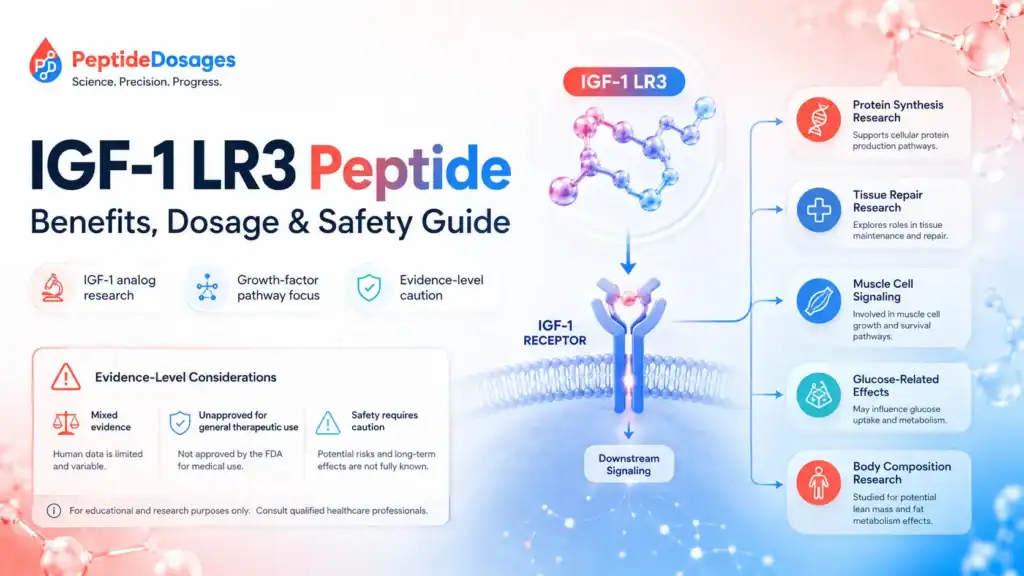
IGF-1 LR3 peptide is a synthetic analog of insulin-like growth factor-1 that is discussed in peptide therapy, muscle growth, and tissue-repair contexts, but direct therapeutic evidence in humans is limited 1. This educational guide reviews how IGF-1 LR3 works, what researchers have studied, how claims compare with approved IGF-1 therapy such as mecasermin, and what side effects and safety questions are known from the broader IGF-1 pathway literature 2 3 7 9. It is not personalized medical advice and does not provide dosing, purchasing, injection, reconstitution, cycling, or stacking instructions.
- IGF-1 LR3, also called Long R3 IGF-I, is a modified form of IGF-1 described in research literature as an 83-amino acid analog with reduced affinity for IGF-binding proteins [1].
- FDA-approved IGF-1 therapy exists for specific pediatric growth-failure indications through mecasermin, but that approved drug is not the same as IGF-1 LR3 [2] [3] 4.
- Mechanistically, IGF-1 signaling involves the IGF-1 receptor, insulin receptor cross-talk, PI3K-Akt signaling, MAPK signaling, protein synthesis, and cell-growth pathways [7] [9] 10.
- Claims about muscle growth, muscle development, tissue repair, and body composition are biologically plausible in parts of the IGF-1 pathway literature, but direct human evidence for IGF-1 LR3 as a therapy is not established 12 13 14.
- Potential side effects should be interpreted cautiously because IGF-1 LR3 does not have an FDA-approved prescribing label; related mecasermin labeling highlights risks such as hypoglycemia, intracranial hypertension, lymphoid tissue hypertrophy, slipped capital femoral epiphysis, hypersensitivity, and neoplasia warnings [3].
- There is no FDA-approved IGF-1 LR3 dosage; dosage information from approved mecasermin labeling or published research contexts should not be converted into personal dosing advice [2] [3].
- Regulatory status matters because compounded or unapproved drug products are not FDA-approved for safety, effectiveness, or quality, and IGF-1 and its analogues are prohibited in sport under the World Anti-Doping Agency list 18 19.
Fast Answer
IGF-1 LR3 peptide is a modified analog of insulin-like growth factor-1 developed for research around IGF-1 receptor activity and reduced binding-protein interaction [1]. It is often discussed for muscle growth, recovery, and metabolic effects, but direct high-quality human evidence for therapeutic use is limited, and the approved IGF-1 drug context involves mecasermin rather than IGF-1 LR3 [2] [3] [4]. Safety, dosage, long-term risk, and product-quality questions require clinician-level review, especially because IGF-1 LR3 is not FDA-approved as a medicine [18].
What Is the IGF-1 LR3 Peptide?
IGF-1 LR3 is a synthetic peptide analog of human insulin-like growth factor 1, a growth factor involved in cell growth, metabolism, and developmental biology [1] [7]. The name is often used in research and online peptide discussions, but it should not be treated as interchangeable with approved recombinant human IGF-1 therapy such as mecasermin [2] [3].
The core medical distinction is simple: native IGF-1 is an endogenous hormone, mecasermin is an approved recombinant human IGF-1 drug for specific pediatric indications, and IGF-1 LR3 is an altered IGF-1 analog without an FDA-approved therapeutic label [2] [3] 20.
IGF1-LR3 Peptide Naming Variants and Canonical Terms
You may see the compound written as IGF-1 LR3, IGF1-LR3 peptide, Long R3 IGF-I, or insulin-like growth factor 1 long arginine 3. These names generally refer to the same research analog described as a modified form of IGF-1 with changes intended to alter binding-protein interaction and biological potency in experimental systems [1].
For public health writing, “IGF-1 LR3 peptide” is a clear canonical term. “Peptide” simply means a molecule made of amino acids, and IGF-1-related molecules are long-chain peptide hormones or growth factors rather than dietary supplements [7] [20].
What Does Long-Arginine 3 Mean in the 83-Amino Acid Structure?
Published research describes Long R3 IGF-I as an 83-amino acid analog of IGF-1 that includes an arginine-related modification at position 3 and an extended structure compared with native IGF-1 [1]. This is why the name includes “LR3,” short for “long arginine 3,” rather than simply “regular IGF-1.”
The structural change matters because it can change how the IGF-1 molecule interacts with insulin-like growth factor-binding proteins, often abbreviated IGFBPs [1] 8. That laboratory property is not the same thing as proving clinical benefit in humans.
Why Is IGF-1 LR3 Considered an Analog of IGF-1?
IGF-1 LR3 is considered an analog of IGF-1 because it is structurally related to human insulin-like growth factor 1 while being modified from the naturally occurring IGF-1 molecule [1]. In pharmacology, a structural analog may retain activity at a related receptor while differing in binding, potency, metabolism, or duration of action [1] [9].
The available research supports describing IGF-1 LR3 as a synthetic peptide and modified form of IGF-1. It does not support describing it as an approved therapy, a guaranteed anabolic treatment, or a proven peptide for muscle growth in humans [2] [3] 17.
Where Does IGF-1 LR3 Fit in Peptide Therapy?
Peptide therapy is a broad term that can include FDA-approved peptide drugs, investigational peptides studied in clinical trials, compounded medications, and unapproved products promoted online [18]. IGF-1 LR3 fits best in the research and evidence-limited category, not the approved-drug category [2] [3] [18].
Approved peptide drugs are reviewed for a specific indication, formulation, manufacturing quality, labeling, contraindications, and dosage instructions [2] [3]. Unapproved peptides do not receive the same FDA review for safety, effectiveness, or quality [18].
Therapeutic Interest Versus Bodybuilding and Performance Claims
Searches for IGF-1 LR3 often focus on muscle growth, muscle growth and recovery, body composition, or performance. The biological interest comes from the role of IGF-1 signaling in skeletal muscle protein synthesis, anabolism, and cell-growth pathways [12] [13].
That does not make performance claims clinically proven. IGF-1 and its analogues are also prohibited in sport under WADA rules, which reflects anti-doping policy and safety concerns rather than evidence of safe or effective personal use [19].
How Does IGF-1 LR3 Peptide Work?
IGF-1 LR3 works by mimicking aspects of insulin-like growth factor-1 activity, especially interaction with IGF-1 receptor signaling pathways described for IGF-1 biology [1] [9]. The main proposed mechanism involves receptor-mediated signal transduction that can influence cell proliferation, protein biosynthesis, glucose handling, and tissue growth in experimental contexts [7] [9] [10].
The most important limitation is that receptor activation does not automatically predict a therapeutic outcome. A signal seen in a muscle cell, animal model, or in vitro study may not produce meaningful or safe results in humans [13] [14].
How IGF-1 LR3 Works by Mimicking IGF-1 Signaling
IGF-1 signaling begins when an IGF-1-like ligand binds to the IGF-1 receptor, a receptor tyrosine kinase that activates intracellular pathways such as PI3K-Akt and MAPK [9]. These pathways can affect protein synthesis, cell proliferation, cellular differentiation, and survival signals depending on tissue type and physiologic context [7] [9].
Long R3 IGF-I was designed to retain pharmacological activity of IGF-1 while showing reduced affinity for IGF-binding proteins in experimental systems [1]. In plain language, IGF-1 LR3 binds in ways that can make it a useful research tool, but that does not establish approved clinical use.
What Happens at the IGF-1 Receptor and Insulin Receptor?
The IGF-1 receptor and insulin receptor are related receptor systems, and both participate in metabolic and growth-factor signaling [9] [10]. This overlap helps explain why IGF-1-like agents may have effects related to glucose, insulin sensitivity, cell growth, and anabolic signaling [9] [10].
Because the insulin and IGF pathways overlap, safety concerns can include blood sugar changes. Approved mecasermin labeling emphasizes hypoglycemia risk, especially around food timing, which is relevant to clinical risk interpretation even though mecasermin is not IGF-1 LR3 [3].
Why Mechanism Does Not Guarantee Clinical Benefit
A mechanism can be biologically plausible without being clinically proven. IGF-1 pathway activation may support hypotheses about muscle development, tissue repair, or metabolic effects, but human benefit requires well-designed studies that measure outcomes, adverse events, dose-response, and long-term risk [9] [13].
This is especially important for IGF-1 LR3 because many online claims are extrapolated from basic IGF-1 biology or from approved mecasermin use. Extrapolation is not the same as direct clinical evidence [2] [3] [17].
Mechanism of Action: Receptors, Half-Life, and Metabolism
The mechanism of action for IGF-1 LR3 is best understood as an IGF-1 analog mechanism with altered binding-protein interaction [1]. Native IGF-1 circulates with insulin-like growth factor-binding proteins, which influence distribution, availability, and biologic activity [7] [8].
Claims that IGF-1 LR3 has a longer or more powerful effect in the body than natural IGF-1 should be treated carefully. The strongest published support is that Long R3 IGF-I has reduced affinity for IGF-binding proteins and enhanced potency in experimental systems, not that a specific human therapeutic effect is proven [1].
Insulin-Like Growth Factor-1 Binding Proteins and Half-Life
IGF-binding proteins regulate how much IGF-1 is available to tissues and receptors [7] [8]. Long R3 IGF-I was developed to have reduced affinity for IGF-binding proteins, a property that can increase receptor availability in certain experimental conditions [1].
Half-life claims for IGF-1 LR3 are often repeated online, but public clinical pharmacokinetic data in humans are limited. Without an approved label or robust clinical pharmacology studies, half-life claims should not be used to build personal dosage or administration decisions [2] [3] [18].
Protein Synthesis, Amino Acid Uptake, and Anabolic Muscle Cell Signaling
IGF-1 signaling is linked to protein synthesis through pathways such as PI3K-Akt-mTOR, which are central to skeletal muscle hypertrophy biology [12] [13]. These pathways help explain why IGF-1 LR3 is often discussed in relation to anabolic effects and muscle mass.
The evidence still needs careful grading. Cell-signaling data and animal models can show that a pathway exists, but they cannot prove that IGF-1 LR3 safely increases muscle mass, improves exercise recovery, or promotes muscle growth in people [12] [13] [14].
What Is IGF-1 LR3 Used For or Studied For?
IGF-1 LR3 is mainly discussed as a research analog of IGF-1 rather than an approved therapeutic drug [1] [2] [3]. Its studied or proposed contexts include receptor biology, IGF-binding protein interaction, cell growth, muscle biology, metabolic signaling, and tissue-repair hypotheses [1] [7] [9].
The approved clinical use in this pathway belongs to mecasermin, not IGF-1 LR3. Mecasermin is approved for growth failure in pediatric patients with severe primary IGF-1 deficiency under specific labeling and medical-supervision conditions [2] [3] [4].
Why Mecasermin Is Different in Severe Primary IGF-1 Deficiency
Mecasermin is recombinant human insulin-like growth factor 1 and is approved for specific children with severe primary IGF-1 deficiency or growth hormone gene deletion with neutralizing antibodies to growth hormone, depending on label jurisdiction [2] [3] [4]. It is not approved for secondary IGF-1 deficiency due to causes such as growth hormone deficiency, malnutrition, hypothyroidism, or chronic glucocorticoid use under the U.S. label [3].
Clinical guidelines discuss IGF-I treatment in carefully defined pediatric growth disorders, reinforcing that approved IGF-1 therapy is a specialist-managed medical intervention rather than general peptide therapy 5. Those guidelines do not make IGF-1 LR3 an approved substitute for mecasermin.
Tissue Repair, Regeneration, and Exercise-Recovery Research Contexts
IGF-1 signaling has been studied in skeletal muscle regeneration, hypertrophy, and tissue biology, including animal and mechanistic models [13] [14]. These studies help explain why IGF-1 LR3 is sometimes discussed for tissue repair or exercise recovery.
The translation problem is central. A signal that supports regeneration in a model system does not prove that using IGF-1 LR3 can heal injuries, improve recovery, or produce safe tissue repair in humans [13] [14].
Potential Benefits of IGF-1 LR3 Peptide
The potential benefits of IGF-1 LR3 are mostly hypothetical, mechanistic, or preclinical rather than clinically established. The most common claimed areas are muscle growth, protein synthesis, tissue repair, body composition, and metabolic effects, but direct therapeutic human evidence remains limited [1] [12] [13] [17].
A safer way to read the evidence is to ask what level supports each claim. Approved-label evidence applies to mecasermin for severe primary IGF-1 deficiency, while IGF-1 LR3 claims usually rely on laboratory, animal, or extrapolated pathway evidence [2] [3] [12].
Benefits of IGF-1 LR3 for Muscle Growth: What Evidence Exists?
The benefits of IGF-1 LR3 for muscle growth are not proven in high-quality human therapeutic trials. The biological rationale comes from IGF-1’s role in skeletal muscle signaling and myotube hypertrophy pathways, including PI3K-Akt-mTOR activity [12] [13].
Some preclinical work suggests IGF-1 pathway activity can influence muscle hypertrophy and regeneration, but these findings should not be converted into claims that IGF-1 LR3 can safely increase muscle mass in humans [13] [14]. Human muscle growth depends on many variables, including training, nutrition, endocrine status, age, disease state, and medication exposure.
Why Muscle Growth and Recovery Claims Need Clinical Context
Muscle growth and recovery claims require clinical context because growth-factor signaling can affect more than muscle. IGF-1 pathways also influence glucose handling, soft-tissue growth, skeletal development, and cell proliferation [7] [9] [10].
A “powerful peptide” claim may sound appealing, but potency can increase risk as well as desired activity. Approved mecasermin labeling highlights clinically important adverse effects, including hypoglycemia and tissue-related complications, which is why IGF-1 pathway therapies require medical oversight [3].
What Remains Unclear About Fat Loss and Body Composition?
The growth hormone and IGF-1 axis affects metabolism, lipid handling, carbohydrate metabolism, and body composition in complex ways 11. However, that does not establish IGF-1 LR3 as a fat loss, weight loss, or dieting therapy.
Direct evidence that IGF-1 LR3 causes reliable fat loss in humans is lacking. Claims about adipose tissue, basal metabolic rate, or body composition should be considered unsupported unless they are tied to specific clinical studies and safety data.
What Does Human Research Say About IGF-1 LR3?
Direct human research on IGF-1 LR3 as a therapeutic agent appears limited compared with the human clinical evidence and labeling available for mecasermin [2] [3] [4] [17]. This distinction matters because evidence for human insulin-like growth factor 1 therapy does not automatically transfer to an IGF-1 analog with different binding properties [1] [20].
The available human evidence in the IGF-1 therapy lane is strongest for approved mecasermin use in severe primary IGF-1 deficiency, including clinical development data summarized in regulatory materials and long-term pediatric treatment reports [3] [4] 6.
Are There Clinical Trials of IGF-1 LR3 in Humans?
A ClinicalTrials.gov search for “IGF-1 LR3” is useful for checking registered human research, but trial registries change over time and should not be treated as a complete systematic review [17]. The key practical point is that no FDA-approved therapeutic label provides an indication, dosing regimen, contraindication list, or safety profile for IGF-1 LR3 [2] [3].
This makes IGF-1 LR3 an evidence-limited compound for therapeutic decision-making. Any claim that it is clinically proven for muscle growth, fat loss, recovery, anti-aging, or metabolic enhancement should be treated as unsupported unless backed by specific peer-reviewed human data.
Limits of Inferring From Related Human IGF-1 Therapy
Mecasermin clinical evidence shows that recombinant human IGF-1 can increase growth velocity in carefully selected children with severe primary IGF-1 deficiency [3] [6]. That is an approved medical-use context with specialist monitoring, defined contraindications, and label-based dosage instructions [3] [5].
IGF-1 LR3 differs from native IGF-1 and mecasermin in structure and binding-protein interaction [1] [20]. Therefore, data from approved IGF-1 therapy can inform safety concerns and pathway understanding, but it should not be used as proof of IGF-1 LR3 efficacy.
What Does Preclinical Research Suggest About IGF-1 LR3?
Preclinical research supports several mechanistic hypotheses about IGF-1 LR3 and the broader IGF-1 pathway. Long R3 IGF-I was described as having reduced affinity for IGF-binding proteins and enhanced biologic potency in experimental systems [1].
Preclinical evidence is useful for understanding receptor biology and signal transduction. It is weaker for predicting real-world therapeutic outcomes, especially when dosing, route, metabolism, species differences, and long-term safety are unknown [13] [14].
Animal Models of Growth, Skeletal Muscle, and Tissue Biology
Animal models have shown that IGF-1 pathway manipulation can affect skeletal muscle hypertrophy, regeneration, and aging-related muscle biology [14]. These findings help explain why researchers study IGF-1 signaling in muscle and tissue repair.
However, animal models cannot determine whether IGF-1 LR3 is safe or effective for human muscle growth and recovery. Species differences, experimental design, dose, route of administration, and disease context can all change the meaning of a result [13] [14].
In Vitro Findings on Cell Proliferation and Protein Biosynthesis
In vitro studies can explore how IGF-1-like molecules affect cell proliferation, protein biosynthesis, and receptor activity [1] [9]. Long R3 IGF-I is useful in such experiments because reduced IGF-binding protein affinity can make IGF-1 receptor activity easier to study in some settings [1] [8].
These findings should be interpreted as mechanistic. In vitro cell data cannot show clinical efficacy, long-term adverse events, cancer risk, endocrine feedback, or safe dosing in humans.
Why Animal and Cell Studies Have Translational Limits
Translational limits are especially important for growth-factor peptides. IGF-1 receptor signaling participates in normal growth and repair, but it is also connected to proliferation pathways that require safety scrutiny [9] 15.
A model can show that IGF-1 LR3 retains pharmacological activity of IGF-1 as an agonist-like research analog, but it cannot show that personal use is safe. Human studies are needed to establish therapeutic effect, adverse-event rates, pharmacokinetics, contraindications, and drug interactions.
Effects of IGF-1 LR3: Evidence Strength and Claim Quality
The effects of IGF-1 LR3 should be separated into five evidence categories: approved-label evidence, clinical evidence, early human evidence, preclinical evidence, and anecdotal or unsupported claims. For IGF-1 LR3 itself, most therapeutic claims fall into the preclinical, mechanistic, extrapolated, or unsupported categories [1] [17].
| Evidence Area | What Has Been Studied | Evidence Level | What It Can and Cannot Show |
|---|---|---|---|
| IGF-1 LR3 identity and binding | Long R3 IGF-I structure, reduced IGF-binding protein affinity, and experimental potency [1] | Preclinical / mechanistic | Supports pharmacology concepts; does not prove human benefit |
| Severe primary IGF-1 deficiency | Mecasermin for specific pediatric growth failure indications [2] [3] [4] | Approved medical use | Supports approved mecasermin use; does not approve IGF-1 LR3 |
| Muscle growth signaling | IGF-1 pathway activity in myotube hypertrophy, muscle growth, and regeneration models [12] [13] [14] | Preclinical / mechanistic | Supports biological plausibility; does not prove safe human muscle gain |
| Metabolic and body-composition claims | Growth hormone and IGF-axis effects on glucose, lipid, and protein metabolism [10] [11] | Clinical physiology / extrapolated | Explains pathway relevance; does not establish IGF-1 LR3 fat loss |
| Safety concerns | Mecasermin label warnings and IGF pathway cancer-risk literature [3] [15] 16 | Approved-label / epidemiologic / mechanistic | Identifies plausible risks; does not fully define LR3 safety |
Claim Strength Matrix: Supported, Preliminary, or Speculative
A supported claim is one backed by approved labeling or high-quality human clinical evidence for the same compound and indication. For IGF-1 LR3, that level of evidence is not available for common claims such as muscle growth, fat loss, recovery, or anti-aging [2] [3] [17].
A preliminary claim may have animal, cell, or pathway support. A speculative claim is mainly based on anecdotal reports, marketing language, or extrapolation from native IGF-1, regular IGF-1, or mecasermin.
Which Online Claims Remain Anecdotal or Unsupported?
Claims that IGF-1 LR3 can enhance muscle growth and recovery, increase muscle mass, cause fat loss, accelerate healing, or improve body composition are commonly repeated but not established as approved therapeutic outcomes. Published IGF-1 pathway science can explain why these claims sound plausible, but plausibility is not proof [9] [12] [13].
Unsupported claims should be treated with extra caution when they include personal protocols, “best dose” claims, injection instructions, cycles, stacks, or promises of rapid results. These formats bypass the evidence and safety framework used for approved drugs [18].
Side Effects of IGF-1 LR3 and Related IGF-1 Therapy
Side effects of IGF-1 LR3 are not well characterized in an FDA-approved prescribing label because IGF-1 LR3 is not an FDA-approved medicine [2] [3]. The most responsible way to discuss risk is to combine direct uncertainty with known safety concerns from related IGF-1 therapy and IGF-1 receptor biology [3] [9] [15].
The side effects of IGF-1 therapy in approved-label contexts include clinically important risks such as hypoglycemia, intracranial hypertension, lymphoid tissue hypertrophy, slipped capital femoral epiphysis, scoliosis progression, hypersensitivity, and neoplasia-related warnings [3]. Those label warnings should not be ignored when considering any IGF-1 pathway agent.
How Could IGF-1-Like Effects Influence Blood Glucose?
IGF-1-like agents can influence blood glucose because IGF and insulin signaling systems are related [9] [10]. Mecasermin labeling emphasizes hypoglycemia as a major safety issue and instructs administration around meals or snacks in the approved pediatric context [3].
For IGF-1 LR3, the exact glucose risk is not defined by an FDA label. Still, any IGF-1 receptor agonist discussion should consider hypoglycemia risk, diabetes medications, fasting, exercise, and carbohydrate intake under clinician supervision.
Edema, Joint Discomfort, and Soft-Tissue Concerns
IGF-1 pathway activity can influence tissues beyond skeletal muscle, including bone, cartilage, lymphoid tissue, and soft tissue [3] [9]. Mecasermin labeling includes warnings about lymphoid tissue hypertrophy and orthopedic issues such as slipped capital femoral epiphysis and scoliosis progression [3].
Edema and joint discomfort are often discussed in relation to growth-factor and endocrine therapies. For IGF-1 LR3, the absence of a label means the frequency, severity, and dose relationship of such side effects remain uncertain.
What Long-Term Theoretical Risks Require Caution?
Long-term caution is warranted because IGF-1 signaling participates in cell proliferation and survival pathways [9] [15]. Epidemiologic and mechanistic literature has linked higher circulating IGF-1 or IGF-axis activity with certain cancer-risk questions, although such evidence does not prove that a specific IGF-1 LR3 exposure causes cancer [15] [16].
Approved mecasermin labeling includes warnings related to benign and malignant neoplasia, especially if therapy is used outside recommended indications or in people with risk factors [3]. That warning is relevant to clinician discussions about any agent that may stimulate IGF-1 receptor signaling.
Safety Considerations, Contraindications, and Monitoring
Safety decisions around IGF-1 pathway agents should consider medical history, growth status, endocrine disorders, glucose regulation, cancer history, current medications, and goals of care. For approved mecasermin, the label provides structured warnings, contraindications, monitoring considerations, and dosage limits; IGF-1 LR3 does not have that approved framework [3].
This difference is not a technicality. Regulatory labeling is one of the main tools clinicians use to assess risk, interpret adverse events, and decide whether a therapy is appropriate for a specific indication [2] [3] [18].
Who May Face Higher Risk With IGF-1 Signaling Agents?
People with active or suspected neoplasia, prior hypersensitivity to related products, closed epiphyses in pediatric contexts, or conditions that increase hypoglycemia risk may need special caution based on mecasermin labeling and IGF-axis biology [3] [15]. Individuals using insulin or other glucose-lowering medications also need medication review because IGF-like activity may influence blood sugar [3] [10].
This is not a complete contraindication list for IGF-1 LR3 because no approved label exists for that compound. It is a risk framework drawn from related therapy and mechanism.
When Are Pregnancy, Breastfeeding, Adolescence, or Active Malignancy Especially Concerning?
Pregnancy and breastfeeding require caution because safety evidence for IGF-1 LR3 is not established in those populations. Absence of evidence is not evidence of safety, especially for growth-factor pathways that affect cell signaling and metabolism [9] [15].
Adolescence is also high-risk outside specialist care because growth plates, skeletal development, and endocrine feedback are medically complex. Active or suspected malignancy is particularly concerning because approved mecasermin labeling includes neoplasia warnings and contraindication language around active or suspected cancer [3].
Drug Interactions and Growth Hormone Axis Considerations
Drug interaction evidence for IGF-1 LR3 is limited because it lacks an approved label and established clinical pharmacology profile [2] [3]. The most relevant interaction questions come from insulin-like effects, glucose-lowering medications, and the growth hormone/IGF-1 endocrine axis [3] [10] [11].
A clinician would not interpret IGF-1 LR3 in isolation. They would consider growth hormone status, IGF-1 levels, blood sugar level, nutrition, liver function, thyroid status, and other endocrine variables depending on the medical context [5] [11].
Which Interactions Matter With Insulin or Diabetes Drugs?
Insulin, sulfonylureas, GLP-1 receptor agonists, SGLT2 inhibitors, and other diabetes treatments can affect glucose control, so any IGF-like agent raises medication-review questions. Mecasermin’s hypoglycemia warning makes this especially relevant, even though the label is not an IGF-1 LR3 dosage guide [3] [10].
The safest interpretation is that glucose-related interactions are plausible and clinically important. Personal changes to diabetes medications, carbohydrate intake, or peptide use should not be made based on general online information.
Growth Hormone, IGF-1 Levels, and Endocrine Feedback
Growth hormone stimulates IGF-1 production in the liver and other tissues, and the GH/IGF axis regulates growth, metabolism, and body composition [5] [11]. This axis is one reason IGF-1 levels are used clinically in endocrine evaluation.
IGF-1 LR3 is not growth hormone, and it should not be treated as a simple substitute for diagnosing or managing growth hormone deficiency, insulin-like growth factor deficiency, obesity, or metabolic disease. Approved IGF-I therapy is reserved for specific indications and requires specialist evaluation [3] [5].
IGF-1 LR3 Dosage and Administration: What Do Labels and Studies Tell Us?
There is no FDA-approved IGF-1 LR3 dosage because IGF-1 LR3 is not FDA-approved as a medicine [2] [3]. Dosage and administration information should therefore be limited to approved related labels, published research context, and clinician-supervised interpretation, not personal use instructions.
Study doses should not be interpreted as personal dosing advice. Route, formulation, purity, pharmacokinetics, monitoring, medical condition, and adverse-event risk all affect dosage interpretation [3] [18].
Why Is There No FDA-Approved IGF-1 LR3 Dosage?
An FDA-approved dosage exists only when a product has been reviewed and labeled for a specific indication, population, route, and formulation [2] [3]. IGF-1 LR3 does not have such a label, so “IGF-1 LR3 dosage” claims online are not equivalent to prescribing information.
This matters because dose is not just a number. A labeled dose reflects clinical studies, manufacturing standards, route of administration, contraindications, monitoring, and adverse-event data for a defined drug product [3] [18].
Approved Mecasermin Dosage and Subcutaneous Administration Are Not IGF-1 LR3 Instructions
The approved U.S. mecasermin label describes subcutaneous administration in pediatric patients with severe primary IGF-1 deficiency, with dosing that starts at 0.04 to 0.08 mg/kg twice daily and may be increased under label conditions to a maximum of 0.12 mg/kg twice daily [3]. The label also emphasizes meal or snack timing because of hypoglycemia risk [3].
This information is included only to show approved-label context. It is not an IGF-1 LR3 peptide protocol, not a recommendation to use IGF-1 LR3, and not a self-administration guide.
Why Do Questions About Whether to Inject IGF-1 LR3 Require Medical Supervision?
Questions about whether to inject IGF-1 LR3 involve high-risk medical issues: sterility, product identity, dose accuracy, route of administration, hypoglycemia, endocrine effects, allergic reactions, and legal status. FDA materials explain that compounded drugs are not FDA-approved and that the agency does not verify them for safety, effectiveness, or quality before marketing [18].
This article does not provide injection instructions. Anyone facing a peptide-related medical decision should discuss regulated alternatives, evidence quality, monitoring, adverse events, and legal status with a licensed healthcare professional.
Regulatory Status, Related Therapies, and Clinician Discussion Points
Regulatory status is central to interpreting IGF-1 LR3. Approved therapies, investigational drugs, compounded medications, and unapproved products differ in evidence standards, manufacturing oversight, labeling, and patient protections [2] [3] [18].
For the IGF-1 pathway, mecasermin is the key approved therapy to understand. IGF-1 LR3 is not the same drug and should not be presented as a legally or clinically equivalent alternative [2] [3] [20].
Is IGF-1 LR3 Peptide FDA-Approved or Legal?
IGF-1 LR3 peptide is not FDA-approved as a medicine. FDA materials identify approved mecasermin products and explain that unapproved or compounded products do not undergo the same FDA review for safety, effectiveness, or quality [2] [3] [18].
Legal status can vary by jurisdiction and by how a product is manufactured, prescribed, marketed, imported, or used. In sport, IGF-1 and its analogues are prohibited under the WADA Prohibited List, which is especially relevant to performance-related claims [19].
Compounded or Unapproved Peptides and Quality Risks
Compounded or unapproved peptides can pose quality risks because they may not be reviewed by FDA for identity, potency, sterility, impurities, stability, or effectiveness before use [18]. This concern is especially important for injectable products, where contamination or dose variability can have serious consequences.
A product labeled as a “research peptide” should not be assumed to be safe, legal, sterile, accurately dosed, or appropriate for human use. Regulatory status is part of the safety picture, not a paperwork detail [18].
IGF-1 LR3 Versus Native IGF-1, Regular IGF-1, and Mecasermin
Native IGF-1 is the endogenous insulin-like growth factor involved in growth and metabolism, while mecasermin is recombinant human IGF-1 approved for specific severe primary IGF-1 deficiency indications [3] [7] [20]. IGF-1 LR3 differs from native IGF-1 because it is a modified analog with altered binding-protein interaction described in laboratory research [1].
Unlike regular IGF-1 or approved mecasermin, IGF-1 LR3 lacks an approved therapeutic label, established dosing instructions, and a defined clinical safety profile [2] [3]. That difference should guide every discussion about benefits, risks, and evidence.
What Should Readers Discuss With a Clinician Before Considering IGF-1 Pathway Therapies?
A clinician-focused discussion is safer than trying to interpret IGF-1 LR3 claims in isolation. Useful topics include:
- Whether symptoms or goals relate to a diagnosable endocrine condition rather than a peptide claim [5].
- Whether an approved therapy, such as mecasermin in a specific pediatric context, is relevant or not relevant [3] [4].
- Current medications that affect glucose, insulin, growth hormone, or metabolism [3] [10] [11].
- Personal or family history of cancer, abnormal growth, hypoglycemia, edema, severe headaches, orthopedic problems, or allergic reactions [3] [15] [16].
- Pregnancy, breastfeeding, adolescence, or other special-population concerns where safety evidence is limited [3].
- Whether the evidence is approved-label, clinical, early human, preclinical, or unsupported.
- Whether a product is FDA-approved, investigational, compounded, or unapproved [18].
- How adverse events would be monitored and reported in a regulated medical context.
The safest way to interpret IGF-1 LR3 is through evidence quality, regulatory status, safety data, and clinician-guided decision-making. The strongest conclusions come from approved labeling and well-designed human studies; weaker claims about muscle growth, fat loss, tissue repair, or performance should be treated cautiously.
REFERENCES
- Francis GL, Ross M, Ballard FJ, et al. A highly potent analogue of human insulin-like growth factor-I with reduced affinity for IGF-binding proteins. Journal of Molecular Endocrinology. 1992. DOI: 10.1677/jme.0.0080213.
- U.S. Food and Drug Administration. Drugs@FDA: INCRELEX application information, Application No. 021839. FDA Drugs@FDA database. Accessed for regulatory context.
- DailyMed / National Library of Medicine. INCRELEX—mecasermin injection prescribing information. DailyMed drug-label database. Current label record accessed for indication, dosage, contraindications, warnings, and adverse reactions.
- European Medicines Agency. Increlex: European public assessment report. EMA. Regulatory product information for mecasermin.
- Grimberg A, DiVall SA, Polychronakos C, et al. Guidelines for Growth Hormone and Insulin-Like Growth Factor-I Treatment in Children and Adolescents. Hormone Research in Paediatrics. 2016. DOI: 10.1159/000452150.
- Chernausek SD, Backeljauw PF, Frane J, Kuntze J, Underwood LE. Long-term treatment with recombinant insulin-like growth factor-I in children with severe IGF-I deficiency. Journal of Clinical Endocrinology & Metabolism. 2007. PMID: 17192294.
- Jones JI, Clemmons DR. Insulin-like growth factors and their binding proteins: biological actions. Endocrine Reviews. 1995. PMID: 7540132.
- Firth SM, Baxter RC. Cellular actions of the insulin-like growth factor binding proteins. Endocrine Reviews. 2002. DOI: 10.1210/er.2001-0033.
- Hakuno F, Takahashi SI. 40 years of IGF1: IGF1 receptor signaling pathways. Journal of Molecular Endocrinology. 2018. DOI: 10.1530/JME-17-0311.
- Boucher J, Kleinridders A, Kahn CR. Insulin receptor signaling in normal and insulin-resistant states. Cold Spring Harbor Perspectives in Biology. 2014. DOI: 10.1101/cshperspect.a009191.
- Møller N, Jørgensen JOL. Effects of growth hormone on glucose, lipid, and protein metabolism in human subjects. Endocrine Reviews. 2009. DOI: 10.1210/er.2009-0027.
- Rommel C, Bodine SC, Clarke BA, et al. Mediation of IGF-1-induced skeletal myotube hypertrophy by PI3K/Akt/mTOR and PI3K/Akt/GSK3 pathways. Nature Cell Biology. 2001. DOI: 10.1038/35078154.
- Schiaffino S, Dyar KA, Ciciliot S, Blaauw B, Sandri M. Mechanisms regulating skeletal muscle growth and atrophy. FEBS Journal. 2013. DOI: 10.1111/febs.12253.
- Musarò A, McCullagh K, Paul A, et al. Localized Igf-1 transgene expression sustains hypertrophy and regeneration in senescent skeletal muscle. Nature Genetics. 2001. DOI: 10.1038/85587.
- Pollak M. Insulin and insulin-like growth factor signalling in neoplasia. Nature Reviews Cancer. 2008. DOI: 10.1038/nrc2327.
- Renehan AG, Zwahlen M, Minder C, O’Dwyer ST, Shalet SM, Egger M. Insulin-like growth factor-I, IGF binding protein-3, and cancer risk: systematic review and meta-regression analysis. The Lancet. 2004. DOI: 10.1016/S0140-6736(04)16044-3.
- U.S. National Library of Medicine. ClinicalTrials.gov search: IGF-1 LR3. ClinicalTrials.gov. Registry search used for clinical-research context.
- U.S. Food and Drug Administration. Compounding and the FDA: Questions and Answers. FDA. Official compounding and regulatory safety information.
- World Anti-Doping Agency. The Prohibited List. WADA. Current prohibited-substances framework for sport.
- DrugBank. Mecasermin. DrugBank Online. Drug database entry for recombinant human insulin-like growth factor 1.
Contributing Authors
The following authors are recognized for published research that helped shape the scientific and clinical context discussed in this article.
Robert C. Baxter
Author profile: PubMed Author Search
Robert C. Baxter is a scientific author whose published work is highly relevant to the IGF-binding protein context behind IGF-1 analog research. Because IGF-1 LR3 is discussed partly through its altered interaction with insulin-like growth factor-binding proteins, Baxter’s publications help frame why binding-protein biology matters for interpreting mechanism of action, pharmacology, and evidence limitations. His work is especially useful for distinguishing receptor-pathway plausibility from direct therapeutic evidence in humans.
Selected publications:
- Cellular actions of the insulin-like growth factor binding proteins — Endocrine Reviews, 2002. DOI: 10.1210/er.2001-0033
- IGF binding proteins in cancer: mechanistic and clinical insights — Nature Reviews Cancer, 2014. DOI: 10.1038/nrc3720
Michael Pollak
Author profile: PubMed Author Search
Michael Pollak is a scientific author whose publications are relevant to the safety and evidence-quality context surrounding IGF-1 pathway discussions. His work on insulin-like growth factor signaling in neoplasia helps readers understand why growth-factor receptor activity requires careful interpretation, especially when claims involve unapproved analogs or extrapolation from preclinical research. His publications provide useful background for evaluating long-term theoretical risks without overstating what is known about IGF-1 LR3 specifically.
Selected publications:
- Insulin and insulin-like growth factor signalling in neoplasia — Nature Reviews Cancer, 2008. PMID: 19029956
- The insulin and insulin-like growth factor receptor family in neoplasia: an update — Nature Reviews Cancer, 2012. DOI: 10.1038/nrc3215