
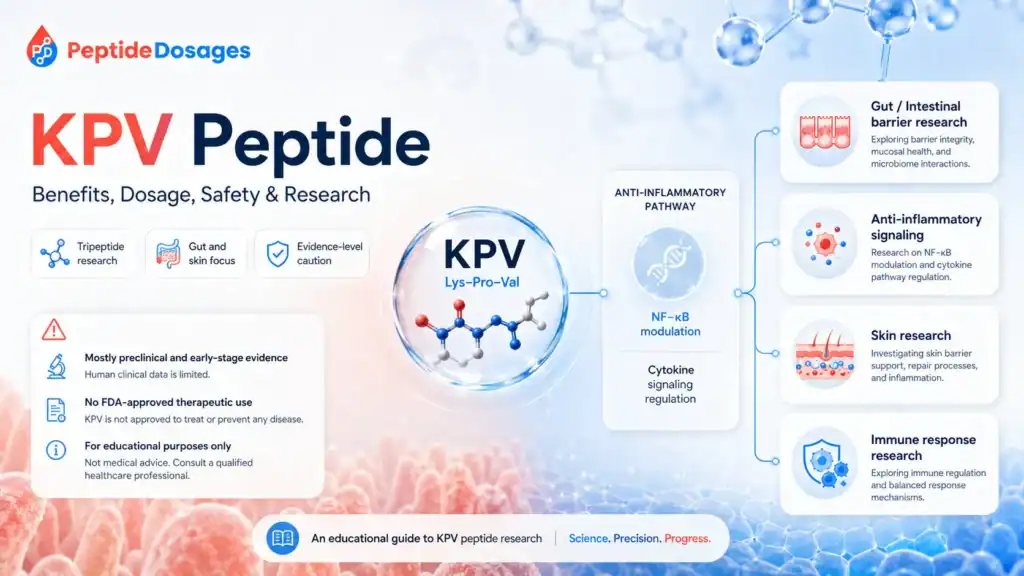
KPV peptide is a short tripeptide, commonly described as the Lys-Pro-Val sequence, that is discussed in anti-inflammatory, gut, and skin research because it is related to the C-terminal region of alpha-melanocyte-stimulating hormone, or alpha-MSH 1 2. This educational guide reviews how KPV is studied, what is known from preclinical and limited human-relevant evidence, and why claims about KPV peptide therapy should be interpreted cautiously. It does not provide personalized medical advice, dosing instructions, injection guidance, or purchasing recommendations.
- KPV is a tripeptide: KPV stands for lysine-proline-valine, a sequence associated with alpha-MSH-related anti-inflammatory peptide research [1] [2].
- The strongest evidence is mechanistic and preclinical: Much of the KPV literature involves cell models, animal colitis models, intestinal epithelial research, and peptide transporter studies rather than large human trials 3 4.
- KPV is mainly discussed for inflammation: Researchers have studied KPV in relation to NF-kB signaling, cytokines, intestinal inflammation, colitis models, and epithelial barrier biology [3] 5.
- Gut health claims need careful framing: Preclinical data suggest possible relevance to gut inflammation and inflammatory bowel disease models, but this does not prove that KPV treats Crohn’s disease, ulcerative colitis, or leaky gut syndrome in humans [3] 6.
- Safety data are incomplete: KPV does not have the kind of approved-label adverse-event profile that FDA-approved drugs have, so side effects and safety should be discussed with caution 9 10.
- Dosage information is not standardized: There is no FDA-approved KPV dosage label; published research exposures are study-specific and should not be converted into personal dosing advice [3] [10].
- Regulatory status matters: KPV is not the same as an FDA-approved medication, and compounded or unapproved peptide products raise quality, labeling, and safety questions [10] 11.
Fast Answer
KPV peptide is a three-amino-acid peptide, Lys-Pro-Val, studied mainly for anti-inflammatory activity related to alpha-MSH biology and intestinal epithelial signaling [1] [2]. People search for it because of claims about gut health, inflammatory bowel disease, skin inflammation, wound healing, and wellness, but the evidence is mostly preclinical or mechanistic rather than based on large human trials [3] [9]. KPV is not an FDA-approved drug, and dosage, safety, and administration questions require clinician-guided interpretation [10] [11].
What Is the KPV Peptide?
KPV is a short peptide made of three amino acids: lysine, proline, and valine [1]. In research literature, it is commonly discussed as a biologically active tripeptide sequence related to alpha-MSH, a melanocortin hormone peptide involved in immune and inflammatory signaling [2].
The phrase KPV peptide is often used in online wellness discussions, but the scientific context is narrower. Published research has focused mostly on inflammation, epithelial cells, peptide transporter 1, colitis models, cytokine signaling, and local delivery strategies [3] [4].
KPV as a Tripeptide From Alpha-MSH
KPV is described as the C-terminal tripeptide sequence of alpha-MSH, a peptide hormone derived from proopiomelanocortin biology [2]. Alpha-MSH and related fragments have been studied for anti-inflammatory properties in immune cells, skin models, and inflammatory disease models [2].
This matters because some online content treats KPV as though it has the same evidence base as an approved drug. It does not; alpha-MSH-related biology provides a mechanistic rationale, not proof of broad clinical benefit.
Peptide Classification, Amino Acids, and Basic Structure
A peptide is a chain of amino acids linked by peptide bonds, and KPV is one of the shortest possible therapeutic-interest peptides because it contains only three amino acids [1]. Its small size is relevant because tripeptides may be transported differently from larger peptide molecules in the gastrointestinal tract [4].
KPV is not a growth hormone secretagogue, anabolic hormone, or metabolic drug. Its research lane is better described as anti-inflammatory peptide biology, especially in gut and skin contexts [2] [3].
Why Is KPV Discussed in Therapeutic Contexts?
KPV is discussed therapeutically because inflammation is central to many chronic conditions, including inflammatory bowel disease, dermatitis, psoriasis, and immune-mediated tissue injury [6] 7. Researchers have explored whether KPV can calm inflammation without broadly suppressing the immune system, although that possibility remains a research question rather than an established clinical fact [2] [3].
For readers, the key distinction is between studied potential and proven treatment. KPV has demonstrated anti-inflammatory activity in preclinical settings, but that is not the same as showing durable benefit and acceptable safety in well-designed human trials [3] [9].
How Does KPV Work?
KPV works, in research models, through proposed effects on inflammatory signaling, epithelial cells, and cytokine pathways [2] [3]. These mechanisms are biologically plausible, but mechanism of action does not automatically predict clinical outcomes in humans.
Inflammation is a complex immune response involving cells, cytokines, transcription factors, barrier tissues, microbiome interactions, and disease-specific triggers [5] [6]. A peptide that affects one pathway in a cell model may not produce the same effect in a person with a chronic condition.
What Anti-inflammatory Pathways Are Proposed?
KPV and related alpha-MSH fragments have been studied for their ability to reduce inflammatory signaling in immune and epithelial contexts [2] [3]. In KPV gut research, investigators have focused on epithelial uptake and changes in inflammatory markers in intestinal models [3].
Commonly discussed pathways include NF-kB signaling, pro-inflammatory cytokines, and epithelial barrier responses [3] [5]. These pathways are relevant because NF-kB regulates many genes involved in inflammatory response, infection defense, cytokine production, and tissue signaling [5].
NF-kB, Cytokine Signaling, and Immune Response
NF-kB is a transcription factor system that helps control inflammatory gene expression [5]. Cytokines such as tumor necrosis factor, interleukin-1 beta, and interleukin-6 are important mediators in inflammatory bowel disease and other immune-mediated conditions [6].
KPV research is often described as anti-inflammatory because studies have examined whether it can reduce inflammatory cytokine signaling in epithelial or immune-cell contexts [2] [3]. However, reducing a cytokine signal in a model does not establish that KPV is effective for disease treatment in humans.
Why Doesn’t Mechanism Prove Clinical Benefit?
A mechanism can explain why a therapy might work, but clinical benefit requires human data showing meaningful outcomes, acceptable side effects, and a favorable safety profile. This distinction is especially important for peptide therapies marketed online before strong clinical evidence exists.
For example, inflammatory bowel disease involves genetics, immune function, gut microbiota, epithelial barrier integrity, environmental triggers, and medication response [6] [7]. A peptide that affects inflammation at the cellular level may still fail to improve symptoms, mucosal healing, quality of life, or long-term disease outcomes in clinical research.
Mechanism of Action: How KPV Works at the Cellular Level
At the cellular level, KPV is mainly discussed in relation to epithelial uptake, inflammatory signaling, and changes in cytokine activity [3]. The most cited gut mechanism involves peptide transporter 1, also called PEPT1, which transports small peptides in intestinal epithelial cells [3] [4].
This mechanism is one reason oral KPV is discussed in research. Still, oral absorption, local intestinal delivery, formulation stability, and human pharmacokinetics are separate questions that require clinical study.
What Happens During Inflammation at the Cellular Level?
During inflammation, immune and tissue cells release chemical signals that recruit other immune cells, alter blood flow, affect tissue permeability, and change gene expression [5] [6]. This response can be protective during infection, but chronic inflammation can damage tissue and worsen disease activity [6].
In the gastrointestinal tract, inflammation may disrupt the intestinal mucosal barrier, increase intestinal permeability, and alter the microbiome environment [6] [7]. KPV research is relevant because some studies have examined whether this tripeptide can reduce inflammatory signaling in epithelial contexts [3].
Peptide Transporter 1 and Oral KPV Research
PEPT1 is a transporter involved in moving dipeptides and tripeptides across intestinal epithelial cells [4]. In a key preclinical study, investigators reported that PEPT1-mediated uptake of tripeptide KPV was associated with reduced intestinal inflammation in experimental models [3].
That finding supports a mechanistic hypothesis for oral KPV, but it does not establish a standardized human dosage or approved therapeutic use. Study formulation, animal species, disease model, route, and endpoints all affect interpretation.
Anti-inflammatory and Antimicrobial Activity in Models
Alpha-MSH-derived peptides and KPV-related sequences have been explored for anti-inflammatory effects, and some literature discusses antimicrobial activity in experimental settings [2]. These findings are scientifically interesting because inflammation and infection can interact in skin, wound, and gut contexts.
However, anti-inflammatory and antimicrobial activity in models should not be interpreted as proof that KPV can treat infections, biofilms, inflammatory skin conditions, or intestinal disease in people. Human safety, dose-response, microbiome effects, and resistance-related questions remain incompletely answered.
What Is KPV Used For or Studied For?
KPV is best described as a research peptide of therapeutic interest, not an approved medication. It has been studied for inflammation-related biology, especially gut inflammation, colitis models, intestinal epithelial barrier function, and skin-related inflammatory pathways [2] [3].
There are no FDA-approved labeled uses for KPV identified in Drugs@FDA, and ClinicalTrials.gov searches do not show the kind of mature clinical-trial record expected for an established therapy [9] [10]. That does not mean research is irrelevant; it means claims should be graded carefully.
Gut Inflammation and Inflammatory Bowel Disease Research
Gut inflammation is one of the most common reasons people search for the benefits of KPV. Preclinical research has examined KPV in intestinal inflammation and colitis models, including mechanisms involving epithelial uptake and inflammatory signaling [3].
Inflammatory bowel disease includes Crohn’s disease and ulcerative colitis, both of which require diagnosis and management by qualified clinicians [7] 8. KPV should not be presented as a replacement for approved IBD therapies such as aminosalicylates, corticosteroids, immunomodulators, biologics, or small-molecule medications used under medical supervision 14 15.
Skin Conditions, Dermatitis, and Psoriasis Research
Alpha-MSH and related peptides have been studied in skin immunology, pigmentation biology, and inflammatory skin pathways [2]. This is why KPV sometimes appears in discussions of dermatitis, psoriasis, acne, skin health, and inflammatory skin conditions.
The evidence should be interpreted cautiously. Mechanistic or preclinical skin findings do not prove that KPV improves psoriasis, dermatitis, acne, or wound outcomes in humans.
What Questions Remain About Wound Healing?
Wound healing involves inflammation, epithelial migration, collagen remodeling, infection control, blood supply, and tissue repair. KPV-related research has raised questions about epithelial injury and inflammatory signaling, but robust human evidence for wound healing outcomes is not established [2] [3].
This is an area where online claims can move faster than published evidence. If wound healing is delayed, infected, painful, or associated with systemic symptoms, it requires medical evaluation rather than peptide self-treatment.
Potential Benefits of KPV Peptide
Potential benefits of KPV peptide are usually framed around inflammation, gut health, skin health, epithelial barrier biology, and immune response. The most responsible way to discuss these benefits is by evidence level.
The table below separates claim areas by the type of evidence available.
| Evidence Area | What Has Been Studied | Evidence Level | What It Can and Cannot Show |
|---|---|---|---|
| Gut inflammation | Intestinal epithelial uptake, PEPT1, colitis-related models, inflammatory signaling [3] [4] | Preclinical | Supports biologic plausibility; does not prove human IBD treatment benefit |
| Cytokine signaling | NF-kB and pro-inflammatory cytokine pathways relevant to inflammation [3] [5] | Mechanistic / preclinical | Shows pathway relevance; does not establish clinical effectiveness |
| Skin inflammation | Alpha-MSH-related anti-inflammatory effects in skin and immune biology [2] | Mechanistic / preclinical | Suggests possible relevance; does not prove benefit for psoriasis or dermatitis |
| Wellness claims | Online claims about gut healing, systemic inflammation, and general wellness [9] [10] | Unsupported or not established | Requires stronger human evidence before therapeutic conclusions |
| Dosage and administration | Study-specific exposures, formulations, and routes [3] | Preclinical / study context | Cannot be converted into personal dosing advice |
What Are the Benefits of KPV for Inflammation?
The main proposed benefit is anti-inflammatory activity. Published literature on alpha-MSH-related tripeptides describes anti-inflammatory properties, and KPV-specific research has examined reduced inflammatory signaling in intestinal models [2] [3].
This does not mean KPV reduces inflammation in every person or condition. Inflammation has different causes, and suppressing the wrong immune response may be harmful in infection, autoimmune disease, or poorly characterized symptoms.
What Evidence Supports Gut and Skin Benefits?
For gut and skin, the evidence is strongest at the mechanistic and preclinical levels. KPV has been studied in intestinal epithelial models and colitis-related research, while alpha-MSH-related peptides have broader literature in skin and immune regulation [2] [3].
The evidence is weaker for patient-centered outcomes. Strong clinical evidence would require controlled human studies measuring symptoms, biomarkers, endoscopy results, skin lesion scores, quality of life, adverse events, and long-term follow-up.
Which Wellness Claims Need Evidence-Based Caution?
Claims that KPV “heals the gut,” fixes “leaky gut syndrome,” eliminates chronic inflammation, or provides broad wellness benefits are not established by high-quality clinical evidence. Terms like leaky gut can refer to intestinal permeability research, but they are often used loosely online and may not correspond to a specific diagnosis.
KPV offers an interesting research story, not a guaranteed wellness intervention. Readers should separate mechanistic plausibility from proven clinical benefit.
Can KPV Therapy Support Gut Health?
KPV therapy is often discussed in relation to supporting gut health because of research on intestinal inflammation, epithelial cells, and PEPT1-mediated tripeptide transport [3] [4]. The phrase “supporting gut health” should be used carefully because it can mean many different things, from symptom relief to microbiome effects to mucosal healing.
In medical research, meaningful gut outcomes usually require defined endpoints. These may include abdominal pain, stool frequency, inflammatory biomarkers, endoscopic healing, intestinal permeability testing, or quality-of-life measures [7] [15].
How Might KPV Affect the Intestinal Barrier?
The intestinal barrier includes epithelial cells, mucus, tight junctions, immune cells, and microbiome-related signaling [6] [7]. KPV may be relevant to this barrier because PEPT1 is expressed in intestinal epithelial biology, and KPV uptake has been studied in relation to intestinal inflammation [3] [4].
This does not prove enhanced gut healing in humans. Barrier function is complex, and a single peptide pathway may not overcome the many drivers of inflammatory bowel disease or systemic inflammation.
What Do Colitis Models Suggest About Chronic Inflammation?
Colitis models are used to study intestinal inflammation, tissue injury, cytokine signaling, and potential therapeutic mechanisms [3] [6]. KPV research in these models suggests possible anti-inflammatory activity, but animal colitis is not identical to human ulcerative colitis or Crohn’s disease.
The translational gap matters. Many agents that reduce inflammation in animal models do not become safe, effective human medications.
What Does Human Research Say About KPV?
Human evidence for KPV appears limited compared with approved inflammatory bowel disease drugs and established anti-inflammatory medications. Searches of ClinicalTrials.gov and FDA approval databases do not show KPV as a mature, approved therapy with labeled indications, standardized dosing, and post-marketing safety data [9] [10].
This means the article should not frame KPV peptide therapy as proven. At most, current evidence supports further research into mechanisms, delivery, and possible therapeutic relevance.
Clinical Evidence and Early Human Findings
The available public evidence landscape is not comparable to FDA-approved drugs that have completed clinical development. For IBD, clinical guidelines discuss approved or guideline-supported therapies based on human trials and clinical outcomes; KPV is not positioned in those guidelines as a standard treatment [14] [15].
If early human or formulation-specific research exists in limited settings, it should be interpreted as preliminary unless replicated in larger, controlled trials. Evidence quality depends on study design, population, comparator, endpoints, safety monitoring, and publication transparency.
Reported Outcomes and Study Endpoints
For a peptide studied in inflammation, meaningful human endpoints would include symptom scores, inflammatory biomarkers, endoscopic measures, histology, medication reduction, relapse rates, adverse events, and quality of life. In IBD, disease definitions and outcomes are complex and differ between Crohn’s disease and ulcerative colitis [7] [8].
Because KPV lacks a robust clinical-trial record, claims about patient outcomes remain uncertain. Mechanistic endpoints should not be substituted for patient-centered clinical benefit.
What Gaps Exist in Safety and Pharmacovigilance Data?
Pharmacovigilance is the ongoing collection and assessment of adverse effects after a drug is used in larger populations. KPV does not have the post-marketing safety record of an FDA-approved drug with labeled adverse reactions, warnings, and risk management requirements [10] 12.
This gap is important for side effects and safety. Minimal side effects reported anecdotally do not equal a proven safety profile.
What Does Preclinical Research Suggest?
Preclinical research suggests that KPV has anti-inflammatory activity in certain experimental systems, especially intestinal epithelial and colitis-related models [3]. These studies help generate hypotheses, identify pathways, and test delivery concepts.
Preclinical findings are useful, but they cannot determine whether a peptide is effective, safe, or appropriately dosed for humans. Translation depends on pharmacokinetics, formulation, disease biology, immune effects, and clinical endpoints.
Animal Models of Colitis and Intestinal Inflammation
Animal models of colitis are commonly used to study gut inflammation, cytokines, epithelial injury, and candidate therapies [3] [6]. KPV studies in this area suggest that the tripeptide may influence inflammatory activity in the gastrointestinal tract.
The limitation is that induced colitis models do not fully reproduce human inflammatory bowel disease. Human IBD involves chronic relapsing disease, genetic susceptibility, microbiome changes, immune dysregulation, and treatment history [7] [8].
Cell Studies on Pro-inflammatory Cytokines
Cell studies allow researchers to examine cytokine signaling, NF-kB activation, gene expression, and epithelial responses under controlled conditions [3] [5]. KPV has been evaluated in this kind of mechanistic context.
Cell studies are not clinical trials. They do not capture drug metabolism, immune-system complexity, adverse effects, microbiome changes, or long-term outcomes in patients.
Translational Limits of Animal and In Vitro Data
A result in an animal or cell model can be biologically meaningful and still fail in humans. Differences in dose, route, formulation, metabolism, disease state, and immune function can change results dramatically.
For KPV, the translational question is not only whether it can reduce inflammatory markers. It is whether any formulation can do so safely, consistently, and meaningfully in defined patient populations.
Where Are the Evidence Limitations and Unsupported Claims?
The largest evidence limitation is the gap between online claims and clinical proof. KPV is widely discussed as a potent anti-inflammatory peptide, but high-quality human data for specific medical uses remain limited.
Evidence limitations should not be treated as proof that KPV is ineffective. They mean the correct conclusion is uncertainty, not certainty in either direction.
How Do Online Claims Compare With Published Evidence?
Online claims often describe KPV as if it reliably reduces intestinal inflammation, heals the gut lining, improves autoimmune symptoms, or enhances wellness. Published evidence is more cautious and mostly focuses on mechanisms, preclinical models, and biologic plausibility [2] [3].
A responsible evidence filter asks: Is the claim supported by FDA labeling, clinical trials, early human evidence, preclinical data, or anecdote? For KPV, most therapeutic claims fall below the level of approved or strongly established clinical evidence [9] [10].
What Remains Unknown About Long-Term Use?
Long-term safety, optimal formulation, human pharmacokinetics, dose-response, drug interactions, pregnancy and breastfeeding safety, immune effects, and effects on infection risk remain unclear. FDA guidance on biologic and therapeutic protein immunogenicity highlights that immune responses to therapeutic molecules can be clinically relevant, even though KPV itself is a small tripeptide rather than a therapeutic protein 13.
Unknowns are especially important for people with chronic inflammatory disease. They may already be using corticosteroids, immunosuppressive drugs, biologics, nonsteroidal anti-inflammatory drugs, or other medications that require coordinated medical management [14] [15].
Side Effects and Safety Concerns
Side effects and safety data for KPV are not as well characterized as they are for approved medications. Because KPV lacks an FDA-approved label, there is no standardized prescribing information listing adverse reactions, contraindications, warnings, drug interactions, or approved dosage [10].
This does not prove KPV is unsafe. It means the safety profile is incomplete and should be interpreted with caution.
What Side Effects Have Been Reported?
Published KPV studies are not sufficient to define a comprehensive human side-effect profile. Reported safety in preclinical or limited settings cannot be assumed to predict real-world effects across different formulations, routes, doses, and patient populations [3] [9].
Potential adverse effects that clinicians generally consider with peptide or biologically active products include local reactions, allergy-like symptoms, contamination-related infection risk, immune effects, gastrointestinal symptoms, and interactions with underlying disease. These concerns are especially relevant when products are compounded or unapproved rather than manufactured and labeled as approved drugs [11] [12].
How Are Adverse Effects Different From Inflammatory Symptoms?
Adverse effects are unwanted effects caused or worsened by an intervention. Inflammatory symptoms, such as abdominal pain, diarrhea, rash, fatigue, or skin irritation, may also come from the underlying condition itself [7] [8].
This overlap can make self-interpretation difficult. A person with IBD symptoms, dermatitis, psoriasis, infection, or abdominal pain should not assume that symptom changes are caused by KPV without clinical evaluation.
When Could Allergic Reaction or Infection Risk Matter?
Allergic reactions matter whenever a biologically active product causes rash, swelling, breathing symptoms, hives, or systemic reactions. Infection risk matters when products are injected, applied to wounds, used in immunocompromised people, or obtained from sources with uncertain sterility and quality standards [11] [12].
This article does not provide injection instructions. Any route involving sterile technique, prescription evaluation, or compounded medication should be handled within appropriate medical and regulatory safeguards.
Safety Profile, Contraindications, and Drug Interactions
The phrase “KPV safe” is too broad. A more accurate question is: safe for whom, in what formulation, at what dose, by what route, for what condition, and with what monitoring?
Because KPV is not an FDA-approved drug, formal contraindications and interactions are not established in official labeling [10]. That absence should not be interpreted as proof that no contraindications or interactions exist.
Is KPV Safe for Everyone?
No peptide or drug should be assumed safe for everyone. Safety depends on medical history, immune status, pregnancy or breastfeeding, current medications, infection risk, allergies, kidney or liver function, and the quality of the product used.
For KPV specifically, the lack of a broad human safety database limits confidence. A clinician may also consider whether there are approved alternatives with known risks and benefits.
Pregnancy, Breastfeeding, Autoimmune Disease, and Chronic Conditions
Pregnancy and breastfeeding require special caution because fetal, neonatal, and lactation-related safety data are often limited for investigational compounds. KPV does not have approved pregnancy or lactation labeling in FDA prescribing information because it is not an approved drug [10].
Autoimmune disease and chronic inflammatory conditions also require caution. People with Crohn’s disease, ulcerative colitis, psoriasis, dermatitis, infection risk, or systemic inflammation may be using medications that change immune function [7] [8] [14] [15].
Anti-inflammatory Drugs, Corticosteroids, and Immunosuppressive Drugs
KPV is often discussed alongside anti-inflammatory goals, but it should not be casually combined with anti-inflammatory drugs, corticosteroids, immunosuppressive drugs, biologics, or small-molecule immune therapies. Standard IBD therapies have evidence-based indications, dosing, monitoring, adverse-effect profiles, and guideline frameworks [14] [15].
Drug interactions for KPV are not well mapped. That uncertainty is a reason for medical review, not a reason to assume safety.
What Dosage Information Exists From Published Studies?
There is no FDA-approved KPV dosage because KPV is not approved as a medication in Drugs@FDA [10]. Published KPV research uses study-specific exposures, routes, formulations, and endpoints, often in preclinical or mechanistic settings [3].
Study doses should not be interpreted as personal dosing advice. A cell-culture concentration, animal-model exposure, or experimental formulation cannot be converted into a safe human protocol without clinical pharmacology and safety data.
What Dosage Has Been Used in KPV Research?
KPV research has used experimental designs that may include in vitro exposure, animal-model administration, oral delivery concepts, and formulation-specific delivery systems [3]. These are not standardized clinical dosage regimens.
A responsible dosage discussion asks whether the dose comes from approved labeling, a registered clinical trial, a peer-reviewed human study, or preclinical research. For KPV, the absence of approved labeling and limited clinical-trial evidence means dosage remains a research-context topic [9] [10].
Why Are Study Doses Not Personal Dosage Advice?
Study doses are chosen for a specific model, species, formulation, route, and endpoint. They may be designed to test a mechanism rather than to produce a clinically useful effect.
Personal dosage decisions require diagnosis, medical history, medication review, contraindication assessment, product quality assurance, adverse-event monitoring, and regulatory compliance. None of those can be replaced by copying a dose from a study.
What Administration Routes Are Discussed in the Literature?
Administration routes discussed in KPV literature include research contexts such as oral exposure, epithelial transport studies, and formulation-specific delivery approaches [3] [4]. Some online discussions also mention topical or subcutaneous administration, but those should not be treated as established or approved routes for self-use.
Route matters because it changes local exposure, systemic absorption, metabolism, immune risk, and safety monitoring. This article does not provide step-by-step administration, mixing, injection, or reconstitution instructions.
Oral, Topical, and Subcutaneous Administration in Research Context
Oral KPV is discussed because tripeptide transport through PEPT1 is biologically plausible in intestinal epithelial research [3] [4]. Topical use is sometimes discussed because alpha-MSH-related peptides have skin immunology relevance [2].
Subcutaneous administration appears in broader peptide therapy conversations, but for KPV it should be treated as a high-risk medical and regulatory topic unless supported by legitimate clinical oversight and product quality controls. Unapproved or compounded products are not equivalent to FDA-approved medications [11] [12].
What Is KPV’s Regulatory Status Compared With Peptide Therapies?
KPV does not appear to have an FDA-approved drug product, labeled indication, approved dosage, or prescribing information in Drugs@FDA [10]. A ClinicalTrials.gov search also does not show the kind of extensive clinical-development record that would support broad therapeutic claims [9].
Regulatory status matters because approved drugs are evaluated for specific indications, manufacturing quality, labeling, dosing, contraindications, adverse reactions, and risk-benefit balance. Unapproved peptides do not carry the same level of regulatory review [12].
How Do FDA Approval, Compounded Peptides, and Related Anti-inflammatory Peptides Differ?
FDA-approved drugs are reviewed for specific uses and manufactured under defined quality standards. Compounded medications may be appropriate in certain circumstances, but FDA notes that compounded drugs are not FDA-approved and are not evaluated by FDA for safety, effectiveness, or manufacturing quality before marketing [11].
Compared with established anti-inflammatory therapies, KPV remains evidence-limited. The safest way to interpret KPV peptide research is through evidence quality, regulatory status, safety data, and clinician-guided decision-making rather than online claims or personal-use protocols.
Readers considering peptide-related medical decisions should discuss evidence, risks, approved alternatives, current medications, pregnancy or breastfeeding status, contraindications, and regulatory status with a qualified healthcare professional. The strongest conclusions come from approved labeling and well-designed human studies; weaker claims should be treated cautiously.
REFERENCES
- National Center for Biotechnology Information. PubChem search for Lys-Pro-Val / KPV. PubChem database. Accessed 2026.
- Brzoska T, Luger TA, Maaser C, Abels C, Böhm M. Alpha-melanocyte-stimulating hormone and related tripeptides: biochemistry, antiinflammatory and protective effects in vitro and in vivo, and future perspectives for the treatment of immune-mediated inflammatory diseases. Endocrine Reviews. 2008. PMID: 18436704.
- Dalmasso G, Charrier-Hisamuddin L, Nguyen HTT, Yan Y, Sitaraman S, Merlin D. PepT1-mediated tripeptide KPV uptake reduces intestinal inflammation. Gastroenterology. 2008. PMID: 18619974.
- Rubio-Aliaga I, Daniel H. Peptide transporters and their roles in physiological processes and drug disposition. Physiological Reviews. 2008. PMID: 18391176.
- Hayden MS, Ghosh S. Shared principles in NF-kappaB signaling. Cell. 2008. PMID: 18267068.
- Neurath MF. Cytokines in inflammatory bowel disease. Nature Reviews Immunology. 2014. PMID: 24486417.
- Ungaro R, Mehandru S, Allen PB, Peyrin-Biroulet L, Colombel JF. Ulcerative colitis. The Lancet. 2017. PMID: 27914657.
- Roda G, Chien Ng S, Kotze PG, et al. Crohn’s disease. Nature Reviews Disease Primers. 2020. PMID: 32242028.
- U.S. National Library of Medicine. ClinicalTrials.gov search for KPV peptide. ClinicalTrials.gov database. Accessed 2026.
- U.S. Food and Drug Administration. Drugs@FDA: FDA-approved drugs database. FDA official database. Accessed 2026.
- U.S. Food and Drug Administration. Compounding and the FDA: Questions and Answers. FDA official guidance page. Updated periodically.
- U.S. Food and Drug Administration. Unapproved Drugs. FDA official regulatory information. Updated periodically.
- U.S. Food and Drug Administration. Immunogenicity Assessment for Therapeutic Protein Products. FDA guidance document. 2014.
- Lichtenstein GR, Loftus EV, Isaacs KL, Regueiro MD, Gerson LB, Sands BE. ACG Clinical Guideline: Management of Crohn’s Disease in Adults. American Journal of Gastroenterology. 2018. PMID: 29610508.
- Feuerstein JD, Isaacs KL, Schneider Y, Siddique SM, Falck-Ytter Y, Singh S. AGA Clinical Practice Guidelines on the Management of Moderate to Severe Ulcerative Colitis. Gastroenterology. 2020. PMID: 31945371.
Contributing Authors
The following authors are recognized for published research that helped shape the scientific and clinical context discussed in this article.
Guillaume Dalmasso
Author profile: PubMed Author Profile
Guillaume Dalmasso is a research author whose published work is directly relevant to KPV peptide and intestinal inflammation models. His publications helped inform the article’s discussion of PEPT1-mediated tripeptide uptake, preclinical research, and the limits of translating model-specific findings into clinical evidence. This work is especially relevant for interpreting KPV as a mechanistic and preclinical research topic rather than an established treatment.
Selected publications:
- PepT1-mediated tripeptide KPV uptake reduces intestinal inflammation — Gastroenterology, 2008. PMID: 18619974
- A biodegradable nanoparticle study delivering an anti-inflammatory peptide in intestinal inflammation models — Gastroenterology, 2010. PMID: 20540944
Didier Merlin
Author profile: PubMed Author Profile
Didier Merlin is a scientific author whose publications are relevant to peptide research, epithelial transport, and preclinical models of gastrointestinal inflammation. His work provides useful context for the mechanism-of-action discussion around KPV, including peptide transporter biology and experimental delivery approaches. These publications support a careful evidence framework for KPV peptide by showing why promising intestinal model data should be interpreted separately from human clinical evidence.
Selected publications:
- PepT1-mediated tripeptide KPV uptake reduces intestinal inflammation — Gastroenterology, 2008. PMID: 18619974
- A biodegradable nanoparticle study delivering an anti-inflammatory peptide in intestinal inflammation models — Gastroenterology, 2010. PMID: 20540944